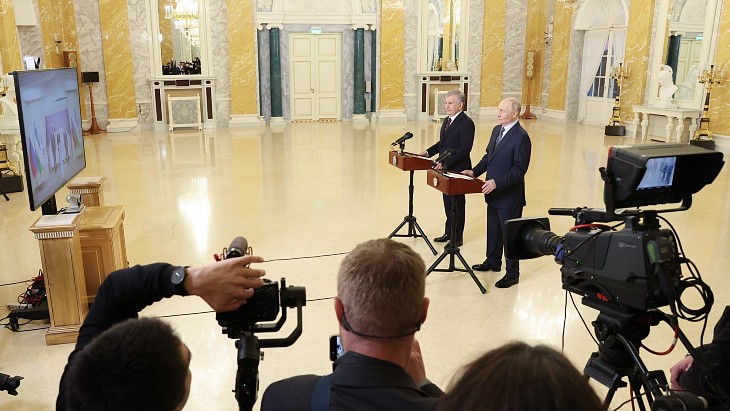
The presidents of Uzbekistan and Russia, meeting in St Petersburg, joined the event via video link, with International Atomic Energy Agency Director General Rafael Mariano Grossi among those attending in person.
Azim Akhmedkhadzhaev, Director of the Uzbekistan Atomic Energy Agency, said: "Today, we are not simply laying the first concrete for the nuclear power plant's foundation. We are laying the foundation for a bright and sustainable future for the Republic of Uzbekistan. This integrated nuclear power plant will symbolise a new technological stage for our country - a stage of energy independence, industrial growth, and environmental security."
"Uzbekistan is confidently moving to the forefront of the global energy sector, strengthening its sovereignty and opening new horizons for innovative development. We are building more than just a power plant - we are laying the foundation for a new era of prosperity, technological leadership, and well-being for future generations of Uzbeks."
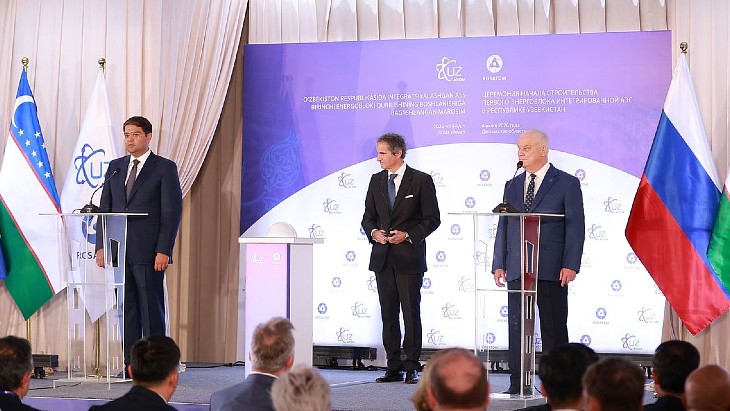
The IAEA's director general was at the ceremony (Image: Uzatom)
First concrete followed the Committee for Industrial, Radiation, and Nuclear Safety under the Cabinet of Ministers of the Republic of Uzbekistan issuing a licence on 4 June to the general contractor for the construction of the nuclear power plant unit's first unit, a Russian-made RITM-200N.
The planned plant
A contract signed in May 2024, during a visit to the country by Russian President Vladimir Putin, was originally for the construction of a 330 MW capacity nuclear power plant featuring six units of the RITM-200N water-cooled small modular reactor (SMR), which is adapted from nuclear-powered icebreakers' technology, with thermal power of 190 MW or 55 MWe and with an intended service life of 60 years. The first unit was scheduled to go critical in late 2029 with units commissioned one by one.
In 2025 a supplemental agreement to the contract for the new nuclear power plant - in the Jizzakh region - covered the decision to change its contents to two gigawatt-scale VVER-1000 units and two SMRs. This increased the proposed capacity to more than 2,100 MWe, compared with the previous 330 MWe.
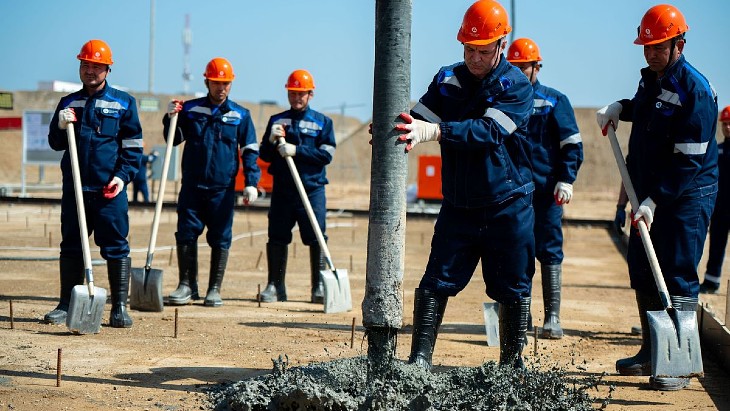
Concrete work at the site began in March (Image: Rosatom)
Excavation work began in October last year for the pit for the first of the SMRs at the site. About 1.5 million cubic metres of soil were excavated during the digging of a pit 13 metres deep. In March this year, Rosatom said that about 900 cubic metres were being poured during the concrete foundation work for the reactor building. That was due for completion in April and it said that the foundation has since been levelled and waterproofed before the pouring of the first concrete for the reactor building's foundation slab.
What the presidents said
President Putin said: "The fact that Russia and Uzbekistan are implementing such a truly flagship high-tech project is a shining example of the friendship and alliance between our two countries ... the project will provide related orders for many Uzbek companies: new jobs will be created, and local contractors will be actively involved in installation, material supply, transportation, and other services. In total, approximately 15,000 people are expected to be employed at the construction site.
"Importantly, Russia will not only build the nuclear power plant but also provide its Uzbek partners with a preferential export loan and support throughout the plant's entire lifecycle. This includes commitments for long-term reactor fuel supplies, servicing and maintenance, and spent nuclear material management. Essentially, with our country's assistance, a national high-tech nuclear industry is being developed in Uzbekistan."
President Shavkat Mirziyoyev said: "Today, we are launching not just the next stage of an infrastructure project, but are participating in an historic event. We are ushering in a new era of technological, industrial, and scientific development for our country. In Uzbekistan, the foundations are being laid for the development of a new field - modern nuclear energy - an industry that symbolises advanced scientific capabilities, cutting-edge engineering expertise, and a strategic vision for the future.
"It is important to note that this project ... is unique in the world; it combines the latest advances in small-scale nuclear generation and large-scale baseload energy."
The IAEA's Grossi noted the uniqueness of the project - which features the first export order for any SMR - and added: "I see investors from other countries here, and they're interested in this project. This project will also contribute to the development of the digital economy, data centres, and other opportunities."
Andrey Petrov, First Deputy Director General for Nuclear Energy at Rosatom, said: "Uzbekistan is embarking on a path of accelerated high-tech development, and Rosatom is honoured to be part of this historic process. Once operational, the nuclear power plant will be able to meet up to 14% of the country's energy needs. Moreover, the nuclear city project we proposed to Uzbekistan will create a new community. The nuclear power plant will be more than just a small town; it will be a true science city - a showcase for cutting-edge nuclear and related technologies."


_33441.jpg)
_17445.jpg)