_17445.jpg)
The company plans to complete a full-power test of its Nuclear Unity Battery - a light-water moderated, helium-cooled transportable microreactor designed to generate 1 MWe. The test builds on its earlier work achieving zero-power criticality through the Nuclear Energy Launch Pad and will provide an opportunity to evaluate system performance, integration, controls, safety and operational procedures at increased scale.
"This is an important step in our path from demonstration to deployment," Deployable Energy said in a post on LinkedIn. "We're proud to build on our earlier zero-power criticality work through NRIC's Nuclear Energy Launch Pad and grateful to the teams at the National Reactor Innovation Center (NRIC), Idaho National Laboratory (INL), and the US Department of Energy (DOE) for creating pathways that help advanced nuclear technologies move toward commercialisation."
The DOE noted that Deployable Energy was competitively selected from the most recent round of applications, submitted in July 2026. Its testing campaign is self-funded. It said the company's experiment timeline is based on criteria including technology readiness, fuel availability and regulatory approval plans. The company must meet specific milestones throughout the process to maintain its allotted time in DOME and ensure efficient use of the test bed.
The Unity microreactor is designed to provide reliable, carbon-free power where conventional energy infrastructure is unavailable, impractical, or vulnerable. Deployable Energy says the technology aims to support a wide range of applications, including remote communities, emergency response operations, defence missions, critical infrastructure resilience, and industrial energy needs.
Unity was the third microreactor to successfully achieve initial criticality at the NRIC located at INL by the 4 July 2026 deadline. Deployable Energy completed the Unity criticality experiment under the Nuclear Energy Launch Pad, an initiative launched in March under the INL-based National Reactor Innovation Center to build on the Reactor Pilot Program, leveraging authorisation from the DOE - rather than the conventional US Nuclear Regulatory Commission licensing route - to expeditiously certify and construct first-of-a-kind advanced nuclear technologies for demonstration. Unity was the first selection under the Launch Pad initiative, in April this year.
DOME
The Demonstration of Microreactor Experiments test bed was built from the repurposed Experimental Breeder Reactor-II (EBR-II) facility at INL.
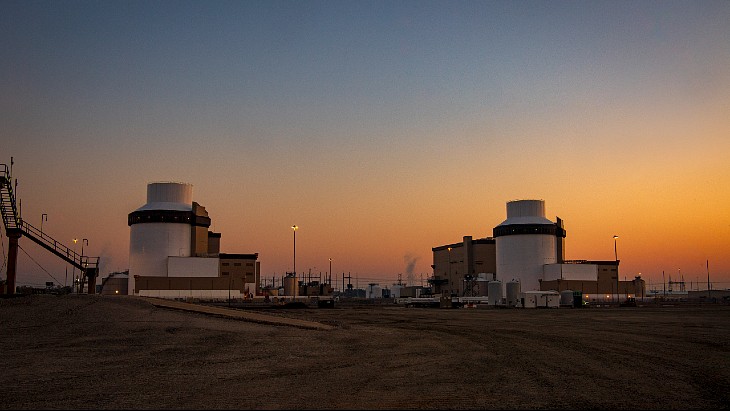
DOME is an actual dome, 100 feet (30 metres) tall and 80 feet in diameter, providing a safe environment to test experimental reactor concepts and gather performance data that can be used to inform future commercial licensing applications, helping to accelerate development timelines and ultimately saving money and reducing project risk.
The facility uses the containment structure of the EBR-II, which operated from 1964 to 1994, and was originally built to demonstrate a complete sodium-cooled breeder reactor power plant. It was later modified to test other reactor designs and to test materials and fuels for fast reactors, as well as generating power and heat for the site. While EBR-II and much of its supporting equipment was subsequently dismantled, the containment structure was left intact and is particularly suited to host reactor demonstration and other nuclear projects.
DOME was declared ready to host its first fuelled microreactor test campaign in April this year.
Deployable Energy will be the second company to test its technology in DOME following its inaugural year-long experiment using nuclear fuel. Radiant is to carry out a five-phase, year-long reactor development testing programme at the facility, progressing from zero-power criticality, through to generating full heat and power and running 150 continuous hours without operator assistance, a crucial milestone for proving its commercial readiness of its 1 MWe Kaleidos transportable microreactor. Westinghouse was also selected last year by the DOE to test the eVinci Nuclear Test Reactor to inform the development of its commercial transportable eVinci microreactor in the DOME.
"The Department of Energy is committed to getting more nuclear power onto the grid," said acting deputy assistant secretary for Nuclear Reactors Chimi Zacot. "Testing at facilities like DOME is how we move these technologies closer to deployment - and closer to our goal of delivering affordable, reliable, and secure electricity for hardworking Americans."
Brad Tomer, NRIC director, added: "We have a strong pipeline of companies interested in the DOME - and that's exactly the kind of momentum we want to see. It shows that developers recognise the value of the resources and data this testing capability provides as they push toward commercialisation."


_51287.jpg)
_82983_12913.jpg)