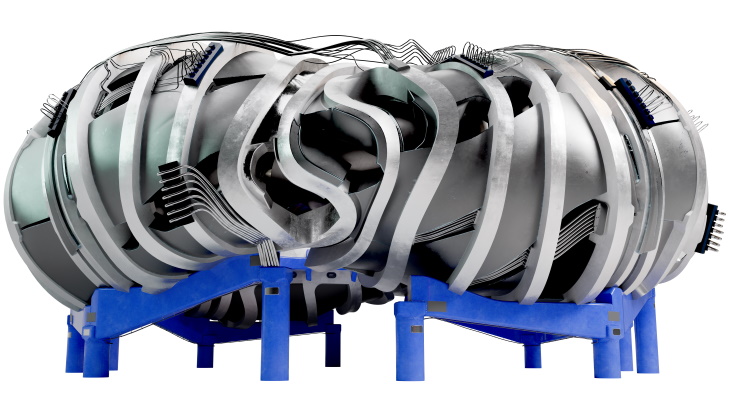
A stellarator fusion reactor is different to a tokamak fusion reactor such as the Joint European Torus in the UK or the ITER device under construction in France. A tokamak is based on a uniform toroid shape, whereas a stellarator twists that shape in a figure of 8. This gets round the problems tokamaks face when magnetic coils confining the plasma are necessarily less dense on the outside of the toroidal ring.
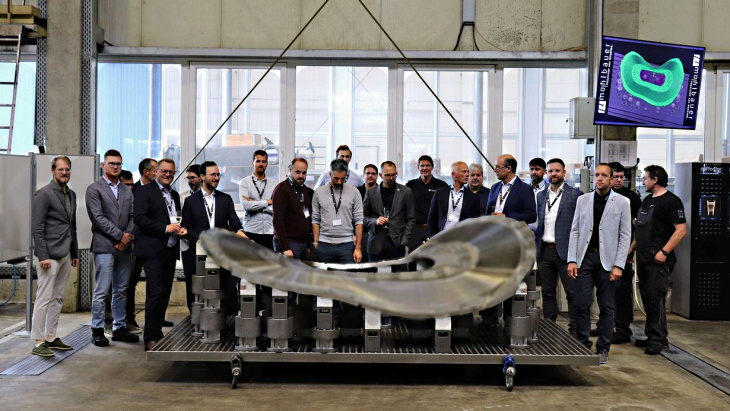
Radial plates are the structural backbone of a superconducting magnet: the high-temperature superconducting (HTS) cables are wound into the plate, which holds them in place. In a quasi-isodynamic (QI) stellarator, the magnet coils are not flat but twisted in three dimensions - and so are the plates. Making non-planar plates to industrial quality is one of the defining manufacturing challenges of QI stellarators.
Lindlar-based Rolf Kind GmbH supplied the base material for the first radial plate for Proxima, while Gilching-based Pro Beam GmbH joined the plate using electron-beam welding. Runding-based Mühlbauer Maschinenbau carried out the precision machining.
The Stellarator Model Coil is a key milestone in Proxima Fusion's magnet programme on the path to Alpha, its net-energy-gain demonstrator, and Stellaris, the first fusion power plant. Proxima said that manufacturing stellarator components brings its engineers and industrial partners together to develop the capabilities needed for Alpha.
(Image: Proxima Fusion)
Pro Beam, Rolf Kind and Mühlbauer are members of Proxima's Alpha Alliance, which brings together more than 50 industrial partners to build Alpha and develop the supply chain for Proxima's first stellarator power plant, Stellaris, and the power plants that follow.
Francesco Sciortino, co-founder and CEO of Proxima Fusion, said: "For stellarator magnets, the three-dimensional geometry is the key challenge in both design and manufacturing. Our engineers and industrial partners have to work through those challenges together. The radial plates are a tangible result of that collaboration: we now have a demonstration of the structural components that will hold the high-temperature superconducting cables of our Stellarator Model Coil. Each delivery builds the manufacturing experience we will carry forward into the magnets for Alpha."
"Power plants usually have big components," said Thorsten Löwer, Managing Director of Pro Beam, which operates the largest electron-beam welding chamber in civil use worldwide. "The challenge in fusion is that you also have to carry big mechanical loads, and do it with incredible accuracy. So this is perfect for electron beam technology, because you can weld with low distortion and a minimal impact on the base material. That helps to achieve high material qualities and tight tolerances, and therefore very precise parts for this new technology."
Markus Kind, Managing Director of Rolf Kind, added: "This component has to deliver extraordinary mechanical properties in its later use. It needs to withstand extreme forces in one of the world's most challenging environments."
"At the end of the day, you have to machine the real part, and at least the final machining has to be right the first time," said Christoph Mühlbauer, Managing Director of Mühlbauer Maschinenbau.
In February this year, Proxima signed an agreement with the Free State of Bavaria, RWE, and Max Planck Institute for Plasma Physics to construct the world's first commercial stellarator fusion power plant at the former Gundremmingen nuclear power plant site. The memorandum of understanding outlines a roadmap to commercial fusion in Europe that begins with building demonstration stellarator Alpha near the Max Planck Institute for Plasma Physics (IPP) in Garching. When operational in the 2030s, Alpha will become the first stellarator to demonstrate net energy gain, meaning its plasma will generate more energy than it consumes. The demonstration stellarator will additionally allow Proxima and its partners to test and validate key fusion technologies under real-world conditions and in shorter development cycles, accelerating the path to building the first stellarator fusion power plant, Stellaris. The Stellaris commercial power plant is planned for the site of a former Gundremmingen nuclear power plant, currently being decommissioned by RWE.