The icebreaker, part of the Project 22220 fleet, features two RITM-200 reactors, which produce 175 MW of thermal power each, and have a service life of 40 years, with refuelling every seven years.
Once both units have had their physical start-up, with launch equipment calibrated to confirm the correct operation of the reactor, controls, protection and monitoring systems, there will then be a series of tests of the nuclear power plant on the vessel.
Each of the units weighs more than 147 tonnes, is 7.3 metres tall, with a diameter of 3.3 metres and is designed to be able to operate in harsh Arctic conditions and to withstand a roll of up to 45 degrees and a pitch of up to 15 degrees.
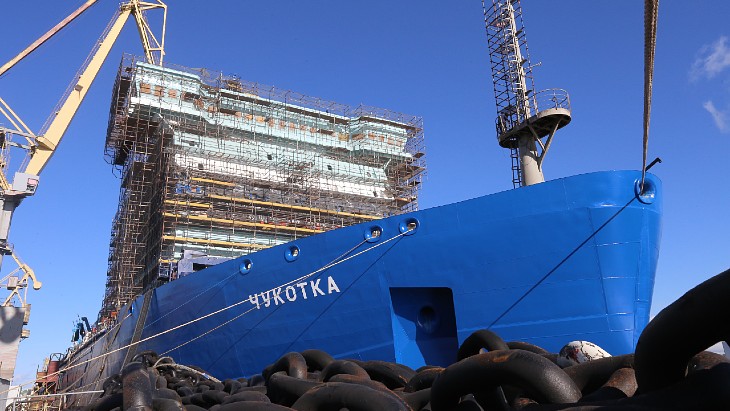
The Chukotka is the fifth of the Project 22220 vessels being built at the United Shipbuilding Corporation Baltic Shipyard. It was laid down in December 2020 and the vessel launched in November 2024 and is currently undergoing mooring trials and preparing for its factory sea trials, the shipyard said.
Background
There are currently a series of Project 22220 nuclear-powered icebreakers operating - the Arktika, Sibir, Ural, the Yakutia, and two under construction, the Leningrad and the Stalingrad at the Baltic Shipyard.
Within Rosatom's machine-building division, Afrikantov OKBM is the designer, complete supplier, and manufacturer of the reactor internals for the RITM-200 and RITM-400 reactor units. Reactor vessel fabrication and test assembly are performed at ZiO-Podolsk. Fifteen RITM-200 reactors have so far been completed, with 13 more under construction.
The Project 22220 vessels are 173 metres long, 34 metres wide and with a height from the waterline to the mainmast of 57 metres. They are designed to break through ice up to three metres thick and have a speed of 22 knots in clear water. The first four have been escorting cargo ships along the Northern Sea Route for several years now.
There is also a larger nuclear-powered icebreaker under construction, the Rossiya, which will be the first of the proposed Project 10510 nuclear-powered icebreakers. It will feature two RITM-400 reactors for a propeller power of 120 MW. It will be able to penetrate ice up to 4.3 metres thick and clear a channel up to 50 metres wide. It has a reported construction target service date of 2030.
Nuclear-powered icebreakers are a key part of Russia's plan to develop the Northern Sea Route, the shipping lane along its north coast which allows faster transport between Europe and Asia.