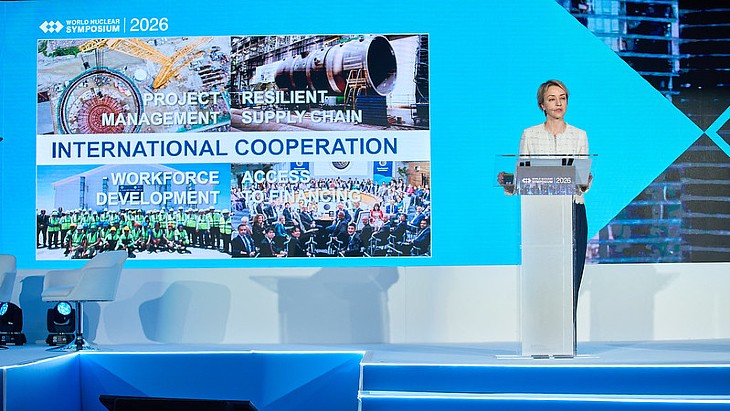
Lion, pictured above, said that Rosatom currently has an international order portfolio of 45 nuclear power units in 10 countries, as well as having completed units in five countries since 2010.
She said that based on Rosatom's experience, in terms of meeting the demand for new nuclear, there were "four priority areas where action is particularly important".
The first area: Delivering nuclear projects on time and on budget
She said: "This is a well-known priority, and the industry is already making significant efforts in this area. I would like to emphasise one fundamental point here. The project schedule cannot be delivered by the vendor alone. It is a shared responsibility of the vendor, the customer, and the host country. A nuclear power plant is not a standard construction project. It is a complex national strategic infrastructure project that requires continuous supervision, multiple regulatory approvals, and in many cases, engagement with international institutions. In our experience, delays may arise not only from construction-related factors, but also from regulatory approvals, which may hold up the next project stage. This is in particular relevant to newcomer countries, where the national regulator and the proper nuclear regulatory framework may still be under development.
"For this reason, building national nuclear expertise is crucial. IAEA support, knowledge exchange with experienced nuclear countries and industrial players, and continuous dialogue between the customer and the vendor are essential."
The second priority: Industrial capacity and supply chain resilience
Lion said: "Every nuclear power plant project must be adapted to the specifics of a particular country. At the same time, standardisation and supply chain resilience become crucial. Rosatom now has to build about 20 nuclear units in parallel in different countries. Just 15 years ago, our production capacity allowed us to manufacture one set of key equipment for a nuclear power plant per year. We understood that this could become a bottleneck and limit our ability to respond to growing market demand. Today, Rosatom can manufacture three such equipment sets per year. Supply chain resilience becomes even more important when we think about SMRs (small modular reactors). Manufacturers across the entire value chain must be able to deliver high-quality equipment on schedule. This is fundamental to scaling nuclear energy. At the same time, the nuclear industry must cooperate with … local construction companies, general equipment manufacturers, and other businesses involved in the development of infrastructure at the site."
She said that on average, about 100 companies are involved in Rosatom's overseas nuclear construction projects. "Localisation is an important factor in the successful delivery of the project and creates a boost for economic growth in the region. According to our estimates, the multiplier effect on related sectors of the economy of the region may reach ten times the total investment into the project itself," she added.
The third priority: Workforce
"Nuclear professions require a highly specialised knowledge base. Not every country has academic infrastructure to train nuclear engineers and operators at scale. These are long-term, high-skill jobs guaranteed for decades, and the key challenge for the industry is to ensure that we have a sufficient amount of professionals to build and operate the nuclear power plant," she said.
"There is no universal model here. In many cases, key specialists involved in the implementation of our nuclear power projects abroad have to come from Russia. And given that nuclear construction projects last for many years, they often move with their families. This means that the project company must also address broader social infrastructure needs, including decent living conditions and access to education for employees' children," added Lion.
"This may seem like a practical detail, but in reality, this is an important component of the nuclear power plant project's sustainability. For example, during the implementation of the Akkuyu Nuclear Power Plant in Turkey, new residential villages were developed with Rosatom support. A new school was opened there, attended by the children of Akkuyu Power Plant employees and by children from local communities. In other cases, experienced personnel may move from one international project to another. For example, from Belarus to Egypt or from Egypt to Bangladesh. This rotation helps transfer practical knowledge and skills across projects and maintain level of qualification among employees.
"At the same time, the long-term objective is to develop qualified personnel within the host country. The full training cycle for a nuclear engineer takes around six years. If we are serious about tripling nuclear capacity in the coming decades, we must make careers in nuclear more visible, more attractive, and more relevant for the next generation of professionals. Public communication, bloggers, podcasts, role models, and success stories can all help us to achieve this."
The fourth priority: Financing
"Access to finance has always been one of the industry's most complex challenges, In this regard, Rosatom has been in a relatively strong position as many of our international projects have been supported by intergovernmental loans, but this model is not universal. Over recent years the global nuclear community, with important leadership from World Nuclear Association and the IAEA, have done significant work to build dialogue with the international financial community. The global green agenda has also played an important role, and the contribution of nuclear energy to climate goals and to sustainable development is well recognised today. We've learned how to issue green bonds and use ESG-linked financing instruments.
"Last year, we saw breakthrough announcements. The World Bank, followed by the New Development Bank and the Asian Development Bank, and many others expressed clear interest in supporting nuclear energy projects. The key task for the nuclear community now is to convert this interest into bankable nuclear power plant projects and particular transactions. Based on our experience, banks are more interested in discussing SMR projects - they require shorter construction timelines and significantly lower capital investment compared with large scale nuclear power plants. We are also seeing growing investment interest in nuclear projects from end users who want to secure access to low-carbon energy.
"At the same time, we should remember that nuclear energy is still relatively new and not a fully familiar asset class for the financial market. This is why dialogue remains crucial - the more nuclear professionals, policy makers, financial organisations, universities, and climate experts talk to each other, the faster we will find practical solutions for tripling nuclear capacity."
She concluded by saying that Rosatom's experience "confirms that global nuclear ambitions cannot be achieved without partnership, mutual trust, and open dialogue".
World Nuclear Symposium, organised by World Nuclear Association, took place in London from 9-11 September.


_55605.jpg)

_18654.jpg)