_54245.jpg)
The Ministry of Finance said the application states that the project involves two large-scale reactors that are estimated to generate 2,500 MW of power.
The ministry said that receiving an application means work can begin on making a decision on providing state support. This includes negotiations between the government and the company on the terms and scope of the support as well as ongoing dialogue with the European Commission to ensure that any support is compatible with the European Union's state aid rules.
"Sweden needs more stable electricity production," said Minister of Financial Markets Niklas Wykman. "It is therefore positive that interest in investing in new nuclear power continues to be high."
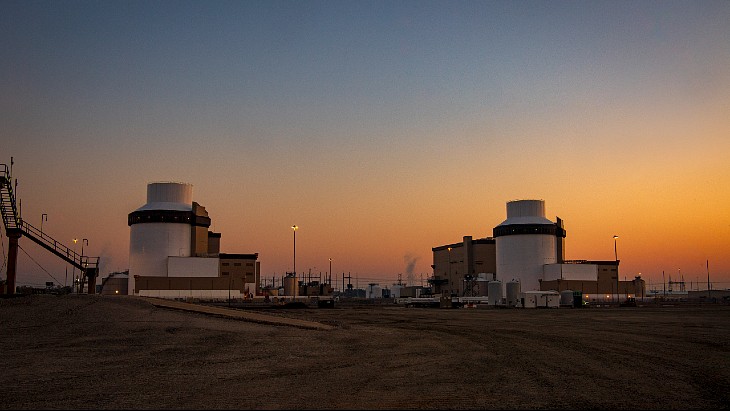
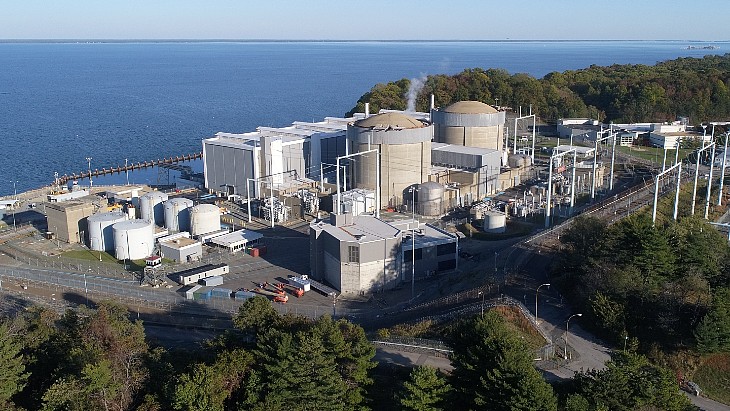
The two ABB-designed boiling water reactors (BWRs) at Barsebäck, about 30 kilometres from Malmö in southern Sweden, shut down in November 1999 and May 2005, respectively. The two 600 MWe reactors - which began operating in 1975 and 1977 - were shut down early because of political pressure from neighbouring Denmark.
In January this year, the Municipality of Kävlinge and Nordic Nuclear Energy (NNE) - part of the same group as Nordic Baseload Power - signed a joint letter of intent regarding cooperation to potentially establish a boiling water reactor in the area where the Barsebäck nuclear power plant is currently being dismantled.
"Kävlinge Municipality is in a unique position in that there is an existing local development plan that allows for additional nuclear power production at Barsebäck," Annsofie Thuresson, Chair of the Municipal Executive Board, said at the time of signing the letter of intent. "Through this cooperation, we now want to examine whether there are conditions for establishing new, modern nuclear power in the area of the former Barsebäck plant."
NNE CEO Göran Engberg said: "We are looking at several sites, but consider Barsebäck to be one of the most interesting, not least because energy demand is so high in electricity price area 4."
NNE's primary development and commercial focus is BWR-N, an evolutionary Nordic boiling water reactor designed for large-scale, fossil-free baseload power and adapted to Nordic regulatory requirements and industrial needs. The design builds on the proven Nordic reactor tradition represented by Forsmark 3 and Oskarshamn 3. The company says its objective is to develop BWR-N as a series-built reactor platform. The company’s initial target is four reactors, with two in Sweden and two in Finland, reflecting the economics of series deployment over one-off construction.
In parallel, NNE is developing micro-modular reactor solutions for local and industrial applications where smaller, flexible and dispatchable energy production is required.
Background
In October 2022, Sweden's incoming centre-right coalition government adopted a positive stance towards nuclear energy. In November 2023, it unveiled a roadmap which envisages the construction of new nuclear generating capacity equivalent to at least two large-scale reactors by 2035, with the equivalent capacity of up to 10 new large-scale reactors (which may include small modular reactors) coming online by 2045. A new act on state aid entered into force on 1 August 2025, since when interested companies have been able to apply for the aid.
The Swedish government received the first such application in December to support proposals for either five GE Vernova Hitachi BWRX-300 reactors or three Rolls-Royce SMRs to provide about 1,500 MW capacity at Ringhals on the Värö Peninsula. The application came from Videberg Kraft AB, a project company owned by Vattenfall AB and backed by a series of industrial firms via the Industrikraft i Sverige AB consortium.
In early June this year, Blykalla submitted an application for government financing for its planned power plant in Norrsundet, Gävle, in east central Sweden, comprising six SEALER reactors, which will have a total generating capacity of up to 330 MWe.
Earlier this week, Studsvik submitted an application for state support for up to 1,400 MW of new nuclear power, featuring small modular reactors, in the southern part of the country, with options at Valdemarsvik and Nyköping forming the basis of the application.


_51287.jpg)