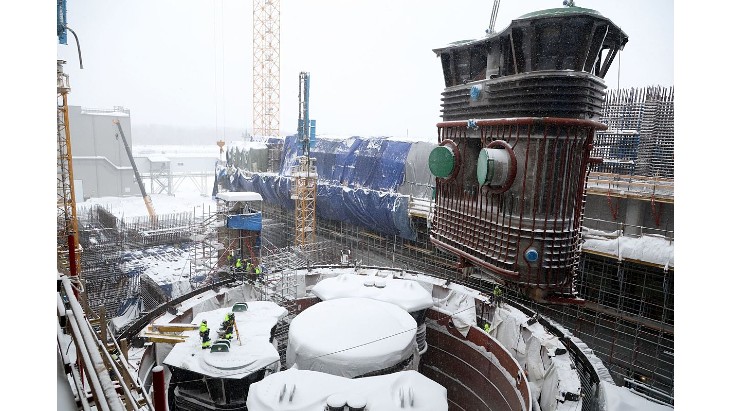
Ivan Babich, from the Experimental and Demonstration Energy Complex at the Siberian Chemical Combine, said: "At the moment, the pressure vessel of the BREST-OD-300 reactor block is approximately 70% assembled."
He said that during 2026 the lead coolant circulation circuit will be formed, the vessel concrete will be completed, and all major internal devices will be installed. "Completion of the reactor vessel assembly is scheduled for the end of 2026," he added.
The next stage will see the reactor's peripheral cavities connected to the central cladding, which was installed in September, forming a closed circuit for the lead coolant circulation. This circuit will eventually house steam generators, main circulation pumps, coolant purification system equipment, and other internal reactor equipment. The central cladding is designed to accommodate the core basket and fuel assemblies, Rosatom said.
The BREST-OD-300 reactor has an integral layout - its vessel is not an all-metal structure, instead it is a metal-concrete structure with the space between the cavities gradually filled with concrete during construction. Because of its large size, it can only be delivered in parts, with assembly only possible at the construction site.
The background
The BREST-OD-300 fast reactor is part of Rosatom's Proryv, or Breakthrough, project to enable a closed nuclear fuel cycle. The 300 MWe unit will be the main facility of the Pilot Demonstration Energy Complex at the Siberian Chemical Combine site. The complex will demonstrate an on-site closed nuclear fuel cycle with a facility for the fabrication/re-fabrication of mixed uranium-plutonium nitride nuclear fuel, as well as a used fuel reprocessing facility.
Recent progress updates included the news in October that the last roofing truss had been moved into place on the turbine hall and the metal shell for the central cavity- which weighs 143 tonnes and is more than 14 metres tall with a diameter of 8 metres - had been installed in place. The four perpheral cavity shells were all installed during December.
Initial operation of the demonstration unit will be focused on performance and after 10 years or so it will be commercially oriented. The plan has been that if it is successful as a 300 MWe (700 MWt) unit, a 1200 MWe (2800 MWt) version will follow - the BR-1200.


_51287.jpg)
_82983_12913.jpg)