Jordan operates a research and training reactor and uses radiation sources in medical, industrial and research applications, has significant uranium resources and is also considering the introduction of nuclear power with small modular reactors.
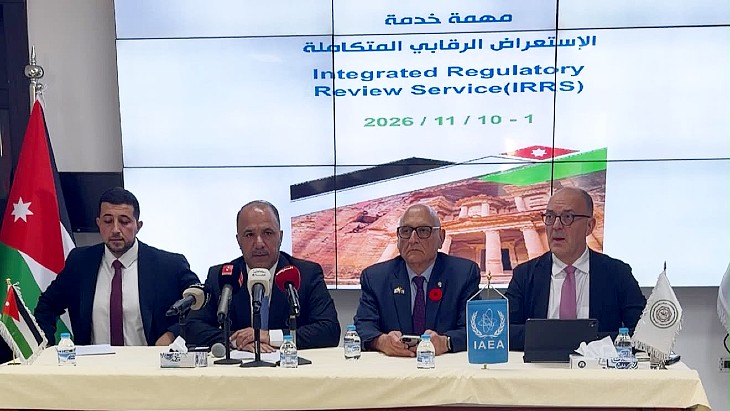
The Integrated Regulatory Review Service (IRRS) review mission involved 12 experts from Brazil, Canada, Croatia, Egypt, Finland, Lithuania, Pakistan, Poland, Portugal, Romania, Sweden and Switzerland and three staff members from the IAEA.
It reviewed the government's and regulatory body's responsibilities and functions; the global nuclear safety regime; the regulatory framework; the integrated management system, regulations and guidance documents; authorisation, review and assessment; inspection and enforcement; and emergency preparedness and response.
Ramzi Jammal, executive vice-president of the Canadian Nuclear Safety Commission and mission team leader, said: "A strong safety framework depends not only on sound laws, institutions and regulatory processes, but also on a sustained commitment to learning and continuous improvement. The IRRS team found these important elements in Jordan."
The seven areas noted by the IAEA mission of good performance by the Energy and Minerals Regulatory Commission included: sustained commitment to international peer review, transparency and continuous improvement; accessible and inclusive communication arrangements; innovative outreach to children and the wider public about radiation safety; promoting radiation protection in industries using naturally occurring radioactive materials; identification and recognition of good performances of licensees; innovative radon mapping in hard-to-access areas; and applying a graded approach to transport emergency preparedness and response.
The four areas for further enhancement included to: further develop the integrated management system; enhance the consistency and effectiveness of core regulatory functions; strengthen specific nuclear and radiation safety requirements and regulatory arrangements; and modernise regulatory records and record-keeping.
Zeyad Al-Saaydeh, chairman of the Energy and Minerals Regulatory Commission, said: "Participating in this IAEA mission reflects Jordan’s commitment to maintaining an independent and effective regulatory system that protects people and the environment ... and represents an opportunity to benefit from international expertise and identify areas for improvement and development, thereby enhancing the nuclear safety and radiation protection system".
The completed mission report will be handed to Jordan's government in about three months.