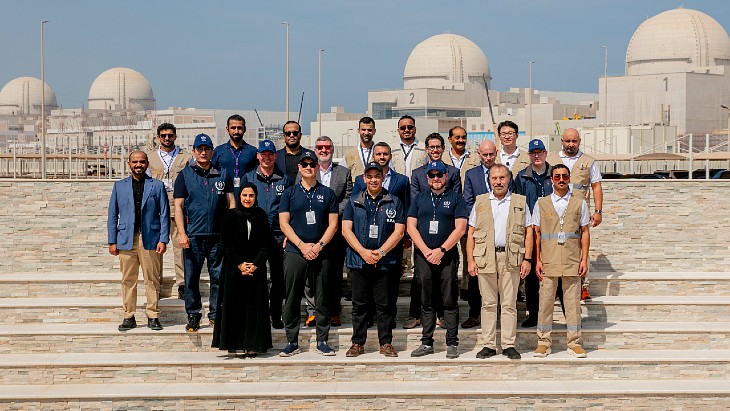
The eight-day mission, by a team of six people, took place at the request of the UAE government. They visited the affected areas of the plant, which is in the Al Dhafra region of Abu Dhabi, and key emergency response facilities and met senior staff from the plant and the Federal Authority for Nuclear Regulation (FANR).
The International Atomic Energy Agency (IAEA) said the mission "focused on plant response actions, national arrangements for emergency preparedness and response, lessons learned from the event, and the reactor operator's arrangements to ensure safety".
It said the team identified good practices and "acknowledged successful restoration of off-site power within a short period following the event, effective regulatory oversight over the event, strengthening of safety procedures, training of operating staff, and resilience of critical infrastructure based on lessons learned from the event".
IAEA Deputy Director General and Head of the Department of Nuclear Safety and Security Karine Herviou said "the real value of an international mission lies not only in confirming what worked, but also in identifying lessons and opportunities for continuous improvements. In this regard, the team recognised the technical knowledge and competence of FANR, the Barakah management and operating personnel, and the national electrical grid field operators".
Recommendations from the expert team included "strengthening emergency preparedness and response arrangements, strengthening the reliability and resilience of critical infrastructure, and reinforcing coordination among relevant stakeholders to ensure the effective integration of nuclear safety and security measures".
Amgad Shokr, Director of the IAEA Incident and Emergency Centre and leader of the mission team, said that the request for the mission showed commitment to safety and continuous improvement, adding: "FANR and ENEC are encouraged to continue implementing the organisational and technical measures identified through the assessment of lessons learned from the event, with the aim of further enhancing safety and strengthening emergency preparedness and response arrangements in line with IAEA Safety Standards."
Hamad Al Kaabi, Director General of FANR, said: "The UAE has established a robust and comprehensive nuclear emergency preparedness and response system in line with the highest international standards, developed in close cooperation with the IAEA.
"The UAE responded swiftly and effectively to the incident, applying the IAEA's Seven Indispensable Pillars for Nuclear Safety and Security. This mission reflects our continued commitment to implementing the highest standards of nuclear safety, security and emergency preparedness, drawing lessons from experience and further strengthening our national capabilities."
Background
The Barakah plant is owned by Emirates Nuclear Energy Company (ENEC) and operated by Nawah, a joint nuclear operations and maintenance subsidiary of ENEC and the Korea Electric Power Corporation.
Construction of the four Korean-designed APR-1400 units at Barakah began in 2012, with work on unit 4 beginning in 2015. Unit 1 began commercial operation in April 2021, unit 2 in March 2022. Unit 3's start-up was in September 2022, and it began commercial operation in February 2023. Unit 4 entered commercial operation in September 2024.
The drone strike happened in May. The IAEA said at the time it had been informed by the UAE that radiation levels at the Barakah Nuclear Power Plant remained normal and no injuries had been reported "after a drone strike ... caused a fire in an electrical generator located outside the inner site perimeter of the NPP". It added that emergency diesel generators were providing power to unit 3.
The UAE's defence ministry said that the drone had been one of three that "entered the country’s territory from the western border direction". The other two were "successfully intercepted".