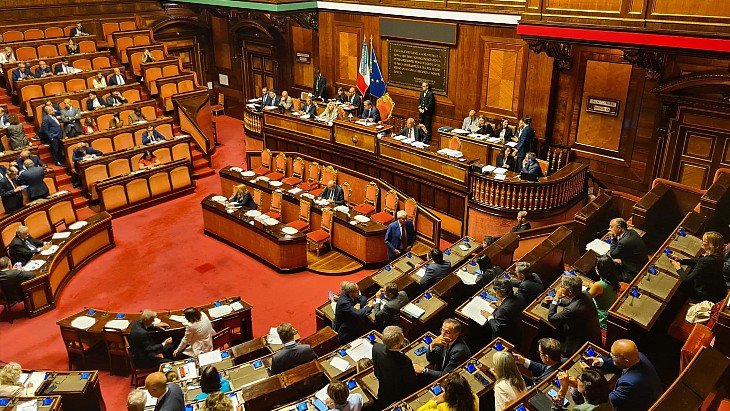
Gilberto Pichetto Fratin, Minister of the Environment and Energy Security, said: "Today, Italy is taking a step toward the future: the approval of the government's mandate for new, sustainable nuclear power completes a process begun three years ago, aimed at exploring the potential of this new, clean, and sustainable technology.
"Nuclear power is not a return to the past: it is a winning technology, which, when integrated with renewables, can deliver extraordinary results for our energy security, toward neutrality by 2050."
Addressing the Senate, he said: "The international climate has changed profoundly in recent years. Energy market volatility, geopolitical tensions, the need to reduce dependence on fossil fuels, and increasingly ambitious decarbonisation goals have highlighted the need for the government to simultaneously ensure environmental sustainability, energy security, and affordability for families and businesses.
In this context, the nuclear debate has taken on a new dimension compared to the past.
"The Government believes that Italy, in this unstable geopolitical context and with strong international competition, cannot stand idly by and watch developments taking place in other countries, which have always benefited from Italy's excellence in this sector. It is therefore essential to develop a comprehensive strategy in which all technologies capable of contributing to emissions reduction and system safety can be analysed and assessed methodically, transparently, and expertly. In addition to the energy and environmental dimensions, the measure also addresses economic and industrial development opportunities for our country.
"The Government recognises that a matter like nuclear energy arouses diverse opinions and sensitivities. For this very reason, it believes it is essential that public debate be based on accurate information, verifiable scientific data, and in-depth technical analysis. Transparency, participation, and dialogue with local communities are essential conditions for building a credible and shared path.
"The ultimate goal, fellow senators, remains to guarantee future generations a safe, sustainable, and competitive energy system capable of supporting Italy's economic and social development."
The bill
In October last year, Italy's Council of Ministers, at a meeting chaired by Meloni, approved a bill delegating responsibility for the reintroduction of nuclear energy in the country to the government. The bill empowers the government to comprehensively regulate the introduction of 'sustainable' nuclear power, within the framework of European policies for decarbonisation by 2050 and energy security objectives. The mandate includes, among other things, the development of a National Programme for Sustainable Nuclear Power, the establishment of an independent Nuclear Safety Authority, the strengthening of scientific and industrial research, the development of new skills, and the implementation of information and awareness campaigns.
In June the bill was passed by the Chamber of Deputies - the lower house of Italy's parliament - with 155 votes in favour, 86 against and eight abstentions.
What next?
Italy already has a number of initiatives under way relating to small modular reactors and advanced nuclear technologies.
On the same day as the vote was held, France's Nuward and its parent company EDF, plus Edison and Italian industrial partners Ansaldo and Maire, stressed their "common vision for the development of small modular reactors (SMRs) in Europe and their ambition to deploy a first reactor in Italy by 2035".
As reported by World Nuclear News, Nuward said last week that it aims to have a fleet of 10 of its SMRs across five European Union member countries, with initial construction beginning in 2030. In a post on LinkedIn on Wednesday, Nuward said: "Beyond the deployment of a first reactor, this momentum creates tangible opportunities for Italian industry to contribute to the development of the technology and become part of the value chain of the future European #SMR programme."
France-headquartered lead-cooled advanced modular reactor developer Newcleo also has considerable operations in Italy, including the first non-nuclear precursor prototype of its lead-cooled fast reactor. Last year it signed a memorandum of understanding with Italian cement association Federbeton to assess the potential for Newcleo’s technologies to work with the cement industry.
Italy's nuclear background
Italy operated a total of four nuclear power plants starting in the early 1960s but decided to phase out nuclear power in a referendum that followed the 1986 Chernobyl accident. It closed its last two operating plants, Caorso and Trino Vercellese, in 1990.
In late March 2011, following the Fukushima Daiichi accident, the Italian government approved a moratorium of at least one year on construction of nuclear power plants in the country, which had been looking to restart its long-abandoned nuclear programme. In a poll held in June of that year, 94% of voters rejected the construction of any new nuclear reactors in Italy.
Since then, Italian public opinion has become more favourable towards nuclear energy. A poll conducted in June 2021 showed that one-third of Italians were in favour of reconsidering the use of nuclear energy in the country.
In May 2023, the Italian Parliament approved a motion to urge the government to consider incorporating nuclear power into the country's energy mix. In September of that year, the first meeting was held of the National Platform for Sustainable Nuclear Power, set up by the government to define a time frame for the possible resumption of nuclear energy in Italy and identify opportunities for the country's industrial chain already operating in the sector.


_33441.jpg)
_17445.jpg)