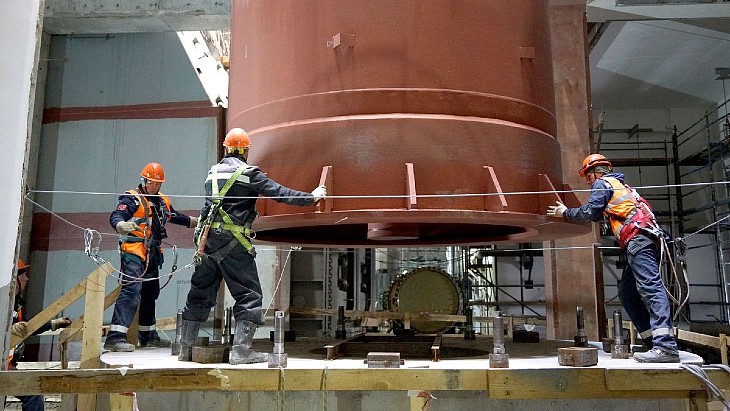
Concrete pouring began in May for the foundation of the turbine and generator for the reactor in Seversk in Russia's Tomsk region, and Rosatom says that construction of the turbine unit foundation will be completed by the end of the year, to allow the installation of the power unit turbine.
A steam separator-superheater's primary function "is to prepare steam for the turbine's low-pressure cylinder. This is necessary to protect the turbine blades from water droplet erosion and to improve the efficiency of the entire steam turbine unit", explained Rosatom.
The background
The BREST-OD-300 fast reactor is part of Rosatom's Proryv, or Breakthrough, project to enable a closed nuclear fuel cycle. The 300 MWe unit will be the main facility of the Pilot Demonstration Energy Complex at the Siberian Chemical Combine site. The complex will demonstrate an on-site closed nuclear fuel cycle with a facility for the fabrication/re-fabrication of mixed uranium-plutonium nitride nuclear fuel, as well as a used fuel reprocessing facility.
Construction began in 2021, and the initial target date for operation was 2026. In October 2025, the last roofing truss was moved into place on the turbine hall and the metal shell for the central cavity - which weighs 143 tonnes and is more than 14 metres tall with a diameter of 8 metres - was installed in place. The four peripheral cavity shells were all installed at the end of 2025 and it was reported that the reactor vessel was approximately 70% assembled. A full-scale control-room simulator was commissioned in July.
Initial operation of the demonstration unit will be focused on performance and after 10 years or so it will be commercially oriented. The plan has been that if it is successful as a 300 MWe (700 MWt) unit, a 1,200 MWe (2,800 MWt) version will follow - the BR-1200.
The World Nuclear Association information paper on fast neutron reactors, says it is a "fast neutron reactor, of 700 MWt, 300 MWe with lead as the primary coolant, at 540°C, and supercritical steam generators. It is inherently safe and uses a mixed uranium and plutonium nitride fuel, the fuel load being 20.6 t. No weapons-grade plutonium can be produced, since there is no uranium blanket – all the breeding occurs in the core. The core breeding ratio is 1.05. Effective enrichment is about 13.5%. Fuel cycle is quoted at 5-6 years with partial refuelling at about 10 months. The initial cores can comprise plutonium and spent fuel - hence loaded with fission products, and radiologically 'hot'. Subsequently, any surplus plutonium, which is not in pure form, can be used as the cores of new reactors. Used fuel can be recycled indefinitely, with on-site facilities. The nitride fuel has been successfully tested in the BN-600 reactor to a burn-up of 7.4%".


_51287.jpg)
_82983_12913.jpg)