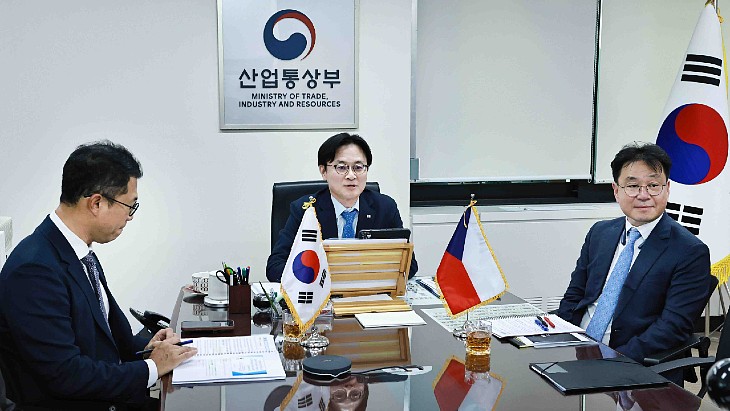
The third steering committee meeting for the Czech new nuclear project was attended by South Korea's Minister of Trade, Industry and Energy Kim Jeong-kwan and Czech Minister of Trade and Industry Karel Havlíček.
According to the Korean ministry's report on the meeting "both sides confirmed that the project has been carried out according to the set schedule to date and reviewed the implementation schedule and plans to ensure the timely execution of key milestones, such as applying for local licensing in the Czech Republic. They also discussed measures to strengthen cooperation between the nuclear industries of both countries in the global nuclear market, not only for the Dukovany project but also for other initiatives".
The ministry added that the minister "conveyed to the Czech side concerns that discussions regarding the EU Industrial Accelerator Act, announced in March 2026, are proceeding in a direction that excessively restricts the participation of non-EU countries in the EU nuclear power market".
The report said he stressed that "cooperation with countries possessing excellent supply chains, such as Korea, is essential for the smooth implementation of nuclear power plant construction plans within the EU, including in the Czech Republic, given the weakened nuclear power supply chain within the EU. He further urged the Czech Republic to continue its diplomatic efforts within the EU to ensure that the Industrial Accelerator Act does not hinder bilateral cooperation as Korea-Czech nuclear cooperation evolves into a larger partnership encompassing advanced industries".
According to the Korean ministry Kim also said he looked forward to continuing the collaboration with the Czech Republic for two more new units at the Temelin plant. These units are currently being considered as a second phase of the Czech Republic's new nuclear programme.
The two sides agreed to hold the 4th Dukovany Implementation Review Meeting in South Korea by the end of the year and also to continue with business-to-business events to strengthen cooperation between the nuclear power industries of the two countries.
Background
ČEZ currently operates four VVER-440 units at Dukovany, which began operating between 1985 and 1987. Their output has gradually been increased from the original 440 MWe to 512 MWe through extensive modernisations.
The Czech government selected Korea Hydro and Nuclear Power as its preferred bidder in July 2024 for two new units near the current plant, about 200 kilometres southeast of Prague. Two further units at the Temelin Nuclear Power Plant - where two VVER-1000 units came into operation in 2000 and 2002 - are also being considered. There are also plans for Rolls-Royce SMR's small modular reactors.
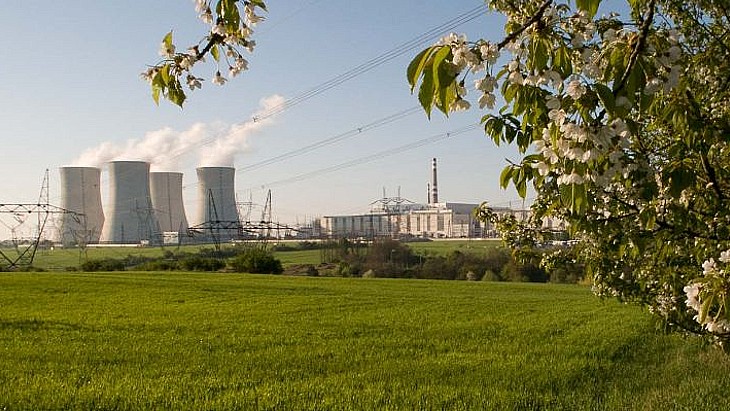
Dukovany (Image: CEZ)
As well as the engineering, procurement and construction contract signed in June 2025 for new capacity at Dukovany, the agreement also includes the supply of nuclear fuel for about a decade - the initial fuel load and five reloads.
The project owner is Dukovany II Nuclear Power Plant, which is 80% owned by the Czech Government and 20% by CEZ, which operates the country's existing nuclear power plants. The cost of the project was said to be CZK407 billion (USD18.6 billion).
The EU's Industrial Accelerator Act was proposed by the European Commission in March. It aims to "strengthen the EU's industrial leadership in strategic sectors, preserve and create around 150,000 jobs in key industrial sectors and accelerate industrial decarbonisation investments through low-carbon and 'Made in EU' provisions in public schemes and procurement".
Its goal is to increase the share of manufacturing in EU GDP from 14.3% in 2024 to 20% by 2035, and one way of achieving this, according to an EU fact sheet released at the time it was proposed, was by using "conditions related to local content, ownership, knowledge and technology transfer, and R&D activities".