_18749.jpg)
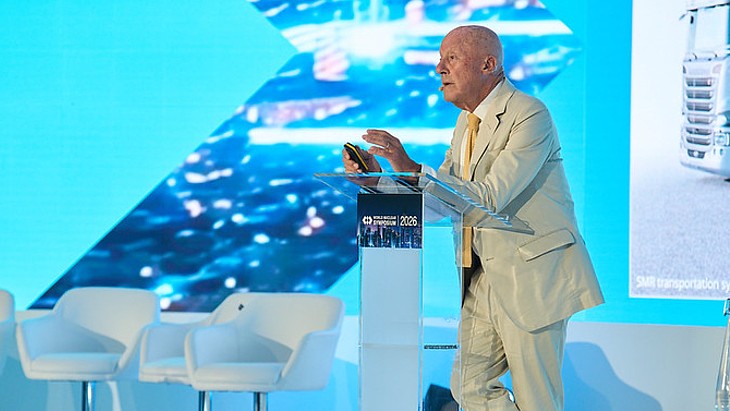
Citing the pledge signed by 38 countries across the world - together making up more than 70% of global GDP - to triple nuclear power by 2050, CEO Meirzhan Yussupov said nuclear energy had "transitioned from a policy debate on paper into operational execution".
"This acceleration in demand is meeting a highly disciplined commercial environment," he said. Long-term uranium price indicators - which have been "incredibly stable" as well as reaching an 18-year maximum - make a "very strong foundation for any future term contracting", he added, with the market showing "clear signals of a fundamental shift" with pricing power returning to producers with proven and large uranium reserves, while utilities' procurement strategies are moving away from reliance on the short-term spot market towards long-term inventory security.
Kazatomprom's consolidated revenue for the first half of the year showed a 9% year-on-year growth to almost KZT718 billion (USD1.57 billion), reflecting financial discipline and favourable uranium market conditions, Yussupov said.
"However, challenging factors have impacted uranium production costs industry-wide, with us experiencing similar pressures. New realities are signalling that the era of 'cheap' uranium is fading away. But the fundamental urgency for secure, baseload, emission-free power is stronger than ever. Global utilities completely recognise this shift, and we are certain that long-term uranium demand is going to be consistent and powerful. Every single pound we produce will have a clear, committed, and waiting buyer," he added.
Alongside the results announcement, Kazatomprom said it has reached an agreement with China's State Nuclear Uranium Resource Development Company Limited (SNURDC) on a spot-term contract for the sale and purchase of natural uranium concentrates. SNURDC is a subsidiary of State Power Investment Corporation Limited.
Kazatomprom has also reached an agreement with Uranium One Group JSC on the sale of natural uranium concentrates, via physical delivery to the Siberian Chemical Plant JSC in Russia. Uranium One is an international group of companies which acts as the key operator for managing Rosatom's foreign uranium mining assets and is responsible for the strategic development of its mineral resource base abroad and is a shareholder in several of Kazatomprom's joint ventures (JV South Mining Chemical Company LLP, JV Akbastau JSC, and Karatau LLP).
The details of both transactions in terms of pricing, volumes and delivery schedules cannot be disclosed due to confidentiality terms, Kazatomprom said, adding that the "transaction parameters comply with current market conditions and prevailing market trends". The agreements are to be put to Kazatomprom's shareholders at an Extraordinary General Meeting scheduled for 11 September.
Recent months have seen several changes to the Subsoil Use Code, the law covering mining in Kazakhstan, with amendments due to come into effect in early September. These include amendments affecting the transfer of uranium mining licences granted to the national operator - currently Kazatomprom - for uranium operations, with stipulations on the minimum equity that Kazatomprom must hold in any entity to which licences are transferred.
Another amendment will see the legal framework for uranium exploration change from a licensing to contracting (subsoil use agreement) regime. Newly issued subsoil use agreements for exploration will be eligible for a one-time extension of up to five years. This amendment allows for a total maximum duration of 11 years for subsoil use agreements on uranium exploration.
Fossil find delays acid plant
In its update, Kazatomprom noted that a new 500-tonnes-per-year processing plant was commissioned by its Ortalyk LLP subsidiary at the Zhalpak deposit in July. Expansion of the facility to a total annual capacity of 900 tonnes is planned for 2027.
However, another major project - the TQZ sulphuric acid plant - is facing delays after the project contractor notified Kazatomprom that it has "encountered potential paleontological specimens" during earthworks at the site. "In accordance with the law on national historical and cultural heritage, construction works in the affected area have been suspended pending official permit from relevant state authorities to resume work," Kazatomprom said. "Specialised excavations will be carried out in the area to safely and fully recover the specimens for comprehensive laboratory analysis."
Sulphuric acid is used in Kazatomprom's in-situ leach uranium operations, but uncertainties over the supply of the vital reagent significantly impacted production plans in recent years. The plant is being constructed by TQZ - a partnership of Italian company Ballestra's Kazakh partner, the licensor and supplier of technology and equipment, with a 60% ownership interest, and Kazatomprom-SaUran LLP with a 40% ownership interest - founded by Kazatomprom in 2023 to implement the construction of the new plant. The total investment cost for the project has been estimated at about KZT113 billion (USD2.6 million).
The final assessment of the impact on the TQZ construction schedule will depend on the outcome of the mandatory regulatory procedures and the receipt of official findings from local authorities, with the timeline for construction subject to the completion of laboratory sample analyses and surrounding area surveys. "Should further samples be discovered or the excavation zone be expanded, a revision of the plant's project design documentation may become necessary to relocate infrastructure facilities outside the affected area," the company added.
"Due to the regulatory suspension of work at the affected zone, the scheduled commissioning date for TQZ, originally targeted for the first quarter of 2027, is now projected to occur between the third quarter of 2027 and the first quarter of 2028, representing an anticipated project schedule shift of 6 to 12 months.
"At this stage, the Company expects that this shift will not have a material impact on its uranium mining operations. Kazatomprom will evaluate the potential impact of this situation with the consideration of existing sources of sulphuric acid. This assessment will be factored into the Company's production guidance for 2027."


_51287.jpg)