Nuclear Waste Services' Director of Sites and Operations, Mike Pigott, and Head of Waste Services Howard Falconer, explain the history of the site, how its operations have changed and its plans for the future - including an update on the prospects for a deep geological disposal facility.
The Low Level Waste Repository's role is to ensure that low-level waste generated in the UK is disposed of in a way that protects people and the environment. The repository site receives low-level solid waste from a range of customers, such as the nuclear industry, the Ministry of Defence, non-nuclear industries, educational, medical and research establishments. Legacy disposal trenches and vaults on the site are now full and ready for permanent closure.
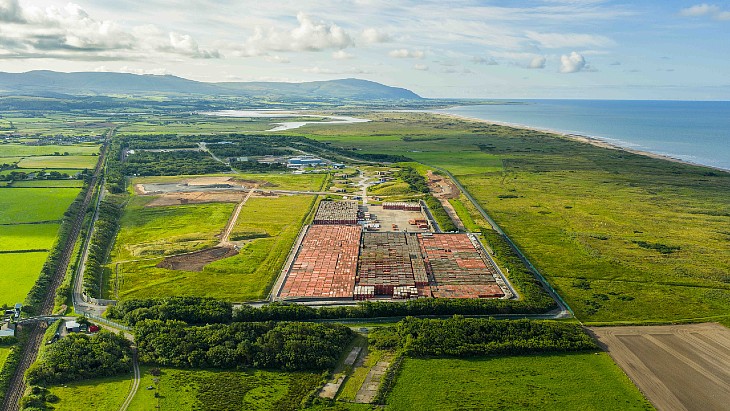
Pigott outlines progress on the capping of the original parts within the 100-hectare site "or about the area of 140 football pitches", which aims to make what began as initially a temporary disposal facility, into a permanent - and environmentally safe - place for the low level waste for thousands of years to come.
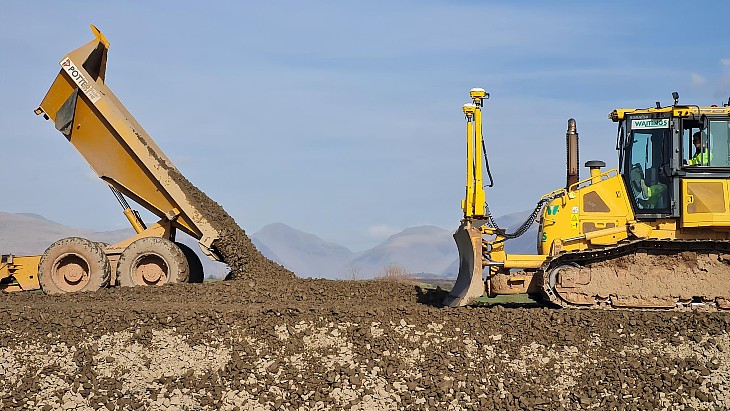
The new cap will be a "passive multi-barrier engineered cap that needs to protect the waste until it's no longer radioactive", and "must ensure there is, ideally, no water infiltration into that waste, and therefore no migration of waste out with any water. And that has to ultimately protect that waste for thousands of years". It is a major construction exercise with about 750,000 cubic metres of aggregates being moved in. To minimise disruption to the local community, this material is being largely brought in by train - Pigott says that eight trainloads a week means avoiding 2,500 HGV movements per month.
(Image: Nuclear Waste Services)
There's been an estimated million cubic metres of material disposed of since 1959, including significant volumes of lightly contaminated building materials, rubble and metals. Although disposal methods have changed over the decades, Pigott praises the foresight of our predecessors with a leachate system underneath the legacy trenches. The environmental and licensing assessments have judged that the capping, which aims to stop any water getting in, can be done on the waste in-situ.
Pigott says the aim with designing the cap is to get a "Goldilocks hill, where it's steep enough that the water runs off and therefore does not percolate into the facility, but also not so steep that it starts to risk erosion as well. Some of it will be 10 metres thick so it'll start to look and feel like another small Lakeland Fell eventually". As well as the aggregates, there is bentonite enriched soil, "a kind of self-repairing clay" - "we can't use any unproven methodologies in the technology that we apply because of the duration that it needs to exist, so we rely upon natural materials".
(Image: Nuclear Waste Services)
The aim is for the initial capping work to be completed by 2034, while more modern parts of the site continue to receive waste. "What we could at a point in time expect to do, but this is going to be decades, probably three or four decades away from where we are now, is potentially be building additional disposal capacity. But right now, because of the success of diversion, we're not expecting to be doing that."
Pigott also gives an update on the UK's search for a site for its proposed deep geological repository, which he describes as operating on all the same principles as the Low Level Waste Repository "but on steroids", with a barrier to protect the environment - "the hazard is somewhat higher and therefore it's deep depth disposal and the barriers that are put in place constitute highly engineered vaults and tunnels to be able to keep that waste safe over hundreds of thousands of years to allow for natural decay of that radioactivity".
Talks have been continuing with two potential host communities and once a preferred option is chosen for a location to take forward exploratory deep borehole drilling to see if it is geologically suitable, that will be passed on to the Energy Secretary to consider and decide upon later this year.
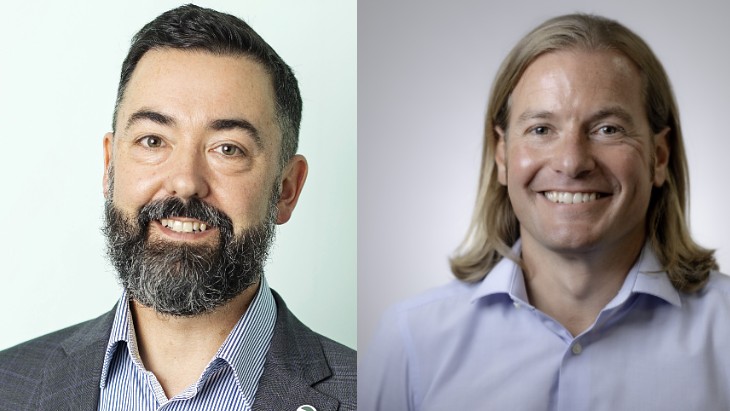
Mike Pigott, left, and Howard Falconer (Image: NWS)
Falconer outlines the sustainability steps taken to reduce the amount of low-level radioactive waste arriving at the site. For instance, reusing material from decommissioning projects in new-build constructions. The result is that there are still many decades-worth of capacity at the site.
"The waste that we generate in the nuclear industry is often nothing special. The vast majority comes from emptying out and knocking down old buildings. It could be things like pipework, process equipment, it could be protective equipment that operators have been wearing, or it might be demolition rubble. And there's obviously other types of waste as well, such as waste from the fuel cycle, for example, or from defence, from research, from pharmaceuticals, those sorts of things," he says.
"Our goal is to ensure that all categories and all types of radioactive waste are managed safely, securely and sustainably ... planning what customers need to do, characterising their waste, providing packaging and containers, providing transport, but ultimately providing routes either to our own disposal facility or to our partners in the supply chain who can provide different treatments and recycling services for us.
"We'll look to clean and recycle waste, in particular metallic waste lends itself to recycling, and disposal is our last resort."
Falconer notes the large amounts of energy and resources that goes into making steel "so if we can recover and clean some of this metallic waste, we can reintroduce it back into the market and it can be used again".
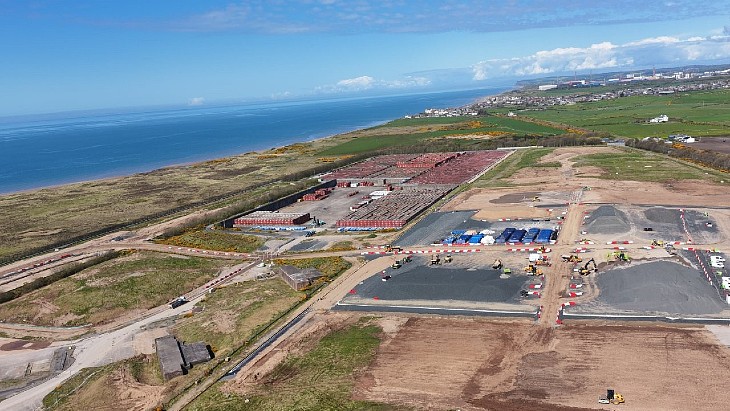
And the techniques are not always hugely innovative - "it could be as simple as saying 'let's just cut off the bit that's radioactive and the rest of it's clean, let's segregate it'. But if that's not possible, ultra high-pressure washing, or grit blasting, or chemical decontamination, or melting the metal, or it could be a combination of some or all of those techniques".
(Image: Nuclear Waste Services)
There are strict controls to ensure safety but the aim is to remove the contamination, which then reduces the amount of material heading for disposal while allowing clean metal to go for recycling.
A key part of the sustainability agenda is to "design out" the waste in the first place, with Falconer saying the aim is to go circular. "Perhaps in future, not only can we recycle some of that metallic waste, but could we recycle it back into something that we could use in the industry? So could we take that steelwork, which was the fabric of a building, clean it, recycle it, and perhaps turn it into a container for moving radioactive material around?" One example is recycled concrete from the turbine plinths at Sizewell A being used in Sizewell C just down the road "so they reduce costs, reduce carbon emissions and reduce the need for generating new materials".
As with other parts of the nuclear energy sector, there are widespread international links between waste services in different countries, where people can learn from others' experiences.
And as to the public perception of nuclear waste as a drawback to nuclear energy, Pigott says that "being open, sharing what we do, and demystifying some of the work" is important, with permanent disposal initiatives, such as at the site in Cumbria, demonstrating how it is possible to safely remove the liability of this material.
You can listen and subscribe on all major podcast platforms:
World Nuclear News podcast homepage
Apple
Spotify
Amazon Music
Episode credit: Presenter Alex Hunt. Co-produced and mixed by Pixelkisser Production
Email newsletter:
Sign up to the World Nuclear News daily or weekly news round-ups


_51287.jpg)