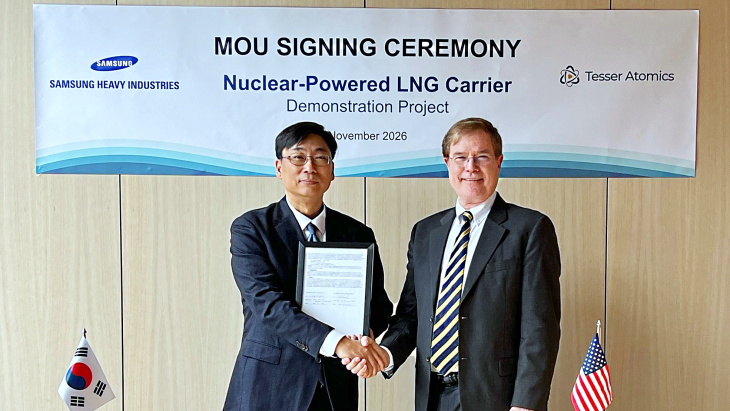
The partners intend to develop the ship concept and marine reactor application. The collaboration combines Samsung Heavy Industries' ship design, integration and construction capabilities with Tesser Atomics' reactor technology and regulatory licensing leadership, creating a defined pathway from concept validation to demonstration and commercial replication.
Under a memorandum of understanding signed on Thursday in Norway, Samsung Heavy Industries becomes Tesser's exclusive shipbuilder partner, while Tesser becomes Samsung Heavy Industries' exclusive reactor partner for the demonstration project to build the first nuclear-powered liquefied natural gas (LNG) carrier.
This demonstration project grew out of NuProShip, the Norwegian research programme that evaluated reactor technologies for merchant ships, and continues within SFI SAINT, of which Tesser is a member. SFI SAINT is led by the Norwegian University of Science and Technology's Department of Ocean Operations and Civil Engineering, and supported by the Research Council of Norway. The demonstration vessel is expected to operate commercially between the USA and Europe.
Tesser's reactor, Triton, is a compact fluoride-salt-cooled high-temperature reactor (FHR) designed for ships. The company says the reactor pairs proven tri-structural isotropic (TRISO) fuel with low-pressure molten salt coolant and online refuelling, in a nuclear module small enough to fit the ship and powerful enough to propel it.
Texas-based Tesser Atomics - co-founded by Per Peterson, who also co-founded Kairos Power - is working to unlock additional market opportunities for KP-FHR technologies while Kairos Power remains focused on grid-scale electricity deployment.
"Shipowners need nuclear fuel that they can trust and a reactor technology that fits the way large cargo ships operate," Peterson said. "Our reactors use TRISO, a proven fuel the US Department of Energy spent more than two decades developing. They refuel while they run, so owners can choose when they want to buy new fuel. Samsung Heavy Industries brings decades of experience designing and building LNG carriers, and we are honoured to work with them toward the first nuclear-powered one."
Kyunghee Kim, Executive Vice President and Head of the Future Business Division at Samsung Heavy Industries, added: "Demonstrating nuclear propulsion on an LNG carrier crossing the Atlantic would open new horizons for decarbonising the shipping industry. Through this project, we aim to prove that a nuclear-powered merchant ship can be deployed on a commercial trade route and give shipowners the evidence they need to choose nuclear propulsion for their next generation of vessels."
The background
In September 2025, Samsung Heavy Industries obtained Approval in Principle from the American Bureau of Shipping (ABS) and the Liberian Registry for a 174,000-cubic-metre LNG carrier powered by a small modular molten salt reactor. The MSR for the carrier was being conceptually designed jointly by Samsung Heavy Industries and the Korea Atomic Energy Research Institute (KAERI). The MSR was designed to have a capacity of 100 MWt and to eliminate the need for fuel replacement during the life of the vessel even if only one unit is installed.
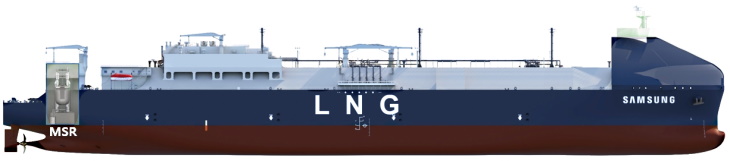
The MSR-powered LNG carrier concept (Image: KAERI)
As part of the Novel Concept Class Approval process, ABS grants an Approval in Principle at an early conceptual design phase to assist the client in demonstrating project feasibility to its project partners and regulatory bodies. Approval in Principle confirms that the proposed novel concept that includes the new technology complies with the intent of the most applicable ABS Rules and Guides as well as required appropriate industry codes and standards, subject to a list of conditions.
At the time, KAERI said obtaining Approval in Principle for the conceptual design was "the first step toward moving forward with actual ship development".
In October 2024, ABS released a study of a small modular reactor on a standard LNG carrier. ABS said the study was designed to help industry "better understand the feasibility and safety implications of nuclear propulsion and to support future development projects". The study considered the impact of a high-temperature, gas-cooled reactor on the design, operation and emissions of a 145,000-cubic-metre LNG carrier design.
The report noted that LNG carrier vessels are increasing in demand as the international LNG trade remains important for global energy security. LNG is stored on board in large cryogenic tanks that maintain natural gas (primarily methane) in a liquid state around -165°C. The typical energy demand for LNG carriers is between 30 to 75 MW.
The shipping industry consumes some 350 million tonnes of fossil fuel annually and accounts for about 3% of total worldwide carbon emissions. In July 2023, the shipping industry, via the International Maritime Organization, approved new targets for greenhouse gas emission reductions, aiming to reach net-zero emissions by, or around, 2050.