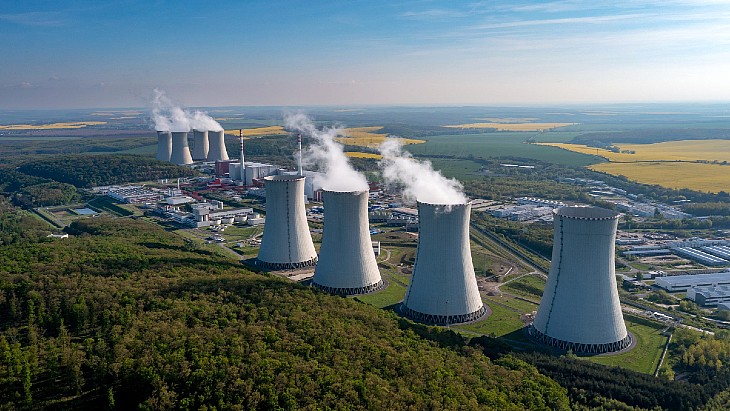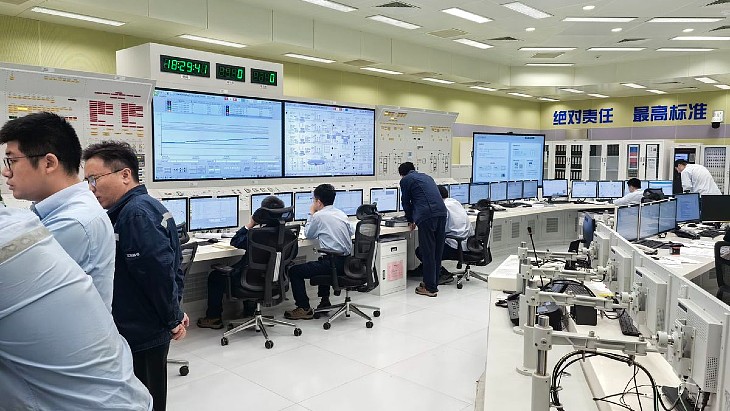
Nuclear fuel was loaded into the reactor core in August and specialists will now conduct a series of tests and checks before the power level can be increased. Such checks and tests will continue as power is increased in stages before getting to full power as part of the commissioning process.
Alexey Likhachev, Director General of the Rosatom, which is building the unit in China, said: "The Tianwan Nuclear Power Plant is a model project for our collaboration with China. Units 1 and 2, built to our design, have been operating here for two decades now. It will soon be 10 years since the launch of Units 3 and 4, and today we are reaching a key milestone in the launch of the new units.
"Our collaboration with Chinese nuclear scientists demonstrates the highest level of coordination and efficiency: construction of Units 7 and 8 began just over five years ago, and today, one could say, the heart of the reactor at Unit 7 has begun beating. This is a great success and an excellent result of our collaboration."
The background
In June 2018, Russia and China signed agreements for the construction of two VVER-1200 reactors as units 7 and 8 of the Tianwan plant. Construction of unit 7 began in May 2021, with that of unit 8 starting in February 2022. The units have been scheduled to be put into commercial operation in 2026 and 2027, respectively.
The Tianwan nuclear power plant is owned and operated by Jiangsu Nuclear Power Company, a joint venture between China National Nuclear Corporation (CNNC) (50%), China Power Investment Corporation (30%) and Jiangsu Guoxin Group (20%).
The first four units at the Tianwan site - which began commercial operation between June 2007 and December 2018 - are Gidropress VVER units supplied by Russia. Units 5 and 6 both feature Chinese ACPR1000 reactors.
In January, CNNC announced that hot tests - which simulate the temperatures and pressures the reactor systems will be subjected to during normal operation - had been completed at unit 7 on 30 December. Cold tests - which verify the leak-tightness of the primary circuit and components - were completed at unit 8 earlier this month.
Once all units at the Tianwan plant are operational, the total installed capacity will exceed 9 GWe, with an annual power generation of over 70 TWh, reducing carbon dioxide emissions by 57.4 million tonnes annually.


_55605.jpg)