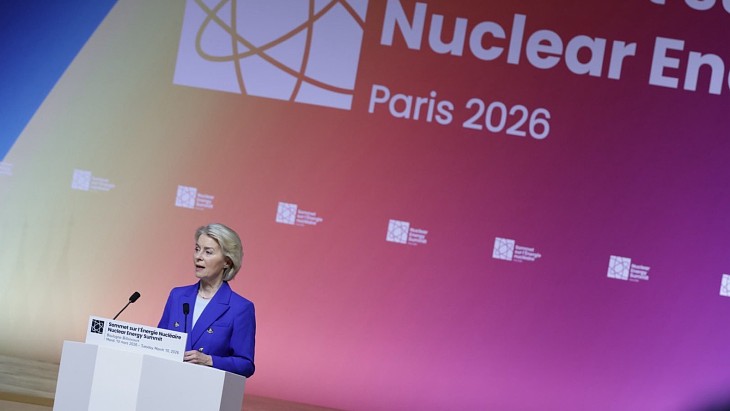
Von der Leyen said the EUR200 million (USD232 million) investment, funded via the Emissions Trading System, will help the European Union's "home-grown low-carbon energy sources: nuclear and renewables … become the joint guarantors of independence, security of supply, and competitiveness - if we get it right - now".
In a speech to the Nuclear Energy Summit being held in Paris, she added: "In 1990 one-third of Europe's electricity came from nuclear, today it is only close to 15%. This reduction in the share of nuclear was a choice, I believe that it was a strategic mistake for Europe to turn its back on a reliable, affordable source of low-emissions power."
She said that with the EU not being an oil or gas producer "the current Middle East crisis gives a stark reminder of the vulnerabilities this creates … nuclear energy is reliable, providing electricity all year, around the clock. So the most efficient system combines nuclear and renewables, and is underpinned by storage, flexibility, and grids … Europe has been a pioneer in nuclear technology and could once again lead the world in it. Next-generation nuclear reactors could become a European high-tech high-value export".
A new European Strategy for Small Modular Reactors will have three main elements, she said: "First, we need simple rules. We will create regulatory sandboxes so that companies can test innovative technology. And we will work with Member States so that rules are aligned across borders. The logic is clear. When it is safe to deploy, it must be simple to deploy – all across Europe.
"Second, we need to mobilise investment. Today I can announce that we will create a EUR200 million guarantee to support private investment in innovative nuclear technologies. And the resources will come from our Emissions Trading System. Not only will we derisk investments in these low-carbon technologies, we also want to give a clear signal for other investors to join. This is one concrete step and part of a broader effort to improve the investment conditions for Europe's nuclear sector.
“Third, this must be a joint European effort. The modular reactors' business model needs scale. So cooperation across European borders is vital. This is why we will work with Member States to align their regulatory frameworks, speed up permitting, and develop the skills the sector needs. Companies from Member States and trusted partners should also come together. For instance, they could co-invest in research, in testing facilities and in creating European value chains for nuclear fuels."
As part of the EU's place in the "nuclear tech race" here would also be strengthening of the "wider nuclear ecosystem - from fuel to technology, from supply chains to skills".
European Union member states are split on the issue of nuclear energy - it is generated in 13 of the 27 EU member states and its vocal opponents have included Germany and Austria. But a growing number of member states are developing plans for new capacity, as well as some countries rethinking their previous phase-out policies.
A Nucleareurope-commissioned report published last year said that with a generating capacity of around 106 GWe, the EU's nuclear sector contributes EUR251.2 billion per year to the bloc's economy and generates yearly public revenues of about EUR47.6 billion, with more than 883,000 jobs sustained.


_55605.jpg)

_18654.jpg)