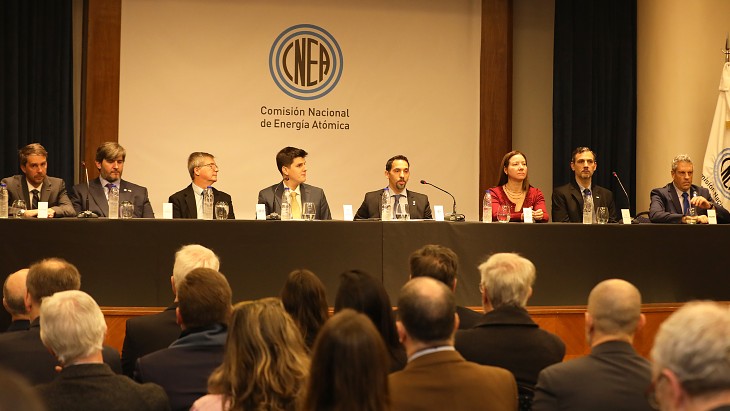
The strategy was outlined in the Guidelines for the Argentine Nuclear Policy 2026 document which was published as the country marked the 76th anniversary of the founding of the National Atomic Energy Commission (CNEA).
According to the CNEA the "update establishes a clear distinction between political leadership and technical operation, promoting for the first time the call for private capital to invest under a scheme that seeks a virtuous circle in which the CNEA contributes research, development and quality professionals and companies finance national projects and take the risk".
Argentina's Secretary of Nuclear Affairs Federico Ramos Napoli said: "The Commission must be based on four fundamental pillars: research, development and innovation so that new advances can generate value; the training of qualified human resources so that Argentina continues to offer top-level professionals; functioning as a technological observatory; and maintaining coordination with the various specialised organisations in the nuclear sector at a global level."
He added that "the mission … is to make the nuclear sector another sector of the economy, capable of positioning Argentina as a key player in global value chains. The country's pre-eminence in the international market is not a loss of sovereignty; it is the consolidation of three-quarters of a century of work".
The policy document says that Argentina "has consistently produced world-class nuclear science and technology but has not managed to convert that production into an industry of equivalent scale … the political task is to close the gap between available capacity and the results achieved".
It says that involving the private sector should not be seen as a threat to the public sector, and says any future investment decisions must start "from the identification of the business opportunity" and then work backwards to "the sizing of the required investment … this sequence reverses the logic that has historically produced the megaprojects of the Argentine sector, in which the investment decision was made on technical assumptions and the commercial question was postponed to later stages that, in most cases, ended up not being realised".
According to CNEA President Martin Porro, writing about the policy document on social media site X: "For decades, the dispersion of efforts and the lack of a common direction postponed the true reach of the sector. Recognising those challenges clearly is not a step backward: it is what gives us the right to build a new stage on solid foundations. We are not starting from zero. We have the infrastructure, the talent, and the projects to compete on the global stage. Our task is to organise that potential and turn technical capacity into industry at scale.
"We seek a virtuous circle, where the CNEA contributes research, development, and quality professionals, and companies invest and assume the risk, under strict state oversight and fiscal discipline. Prestige is not proclaimed from nostalgia: it is sustained by putting all that potential into production. The world is once again betting strongly on nuclear energy, and Argentina has what it takes to respond."
Uranium mining
Meanwhile, Napoli, writing on X the week before the document was published, said that "reactivating uranium mining is a priority for this government".
"Argentina stopped extracting uranium in 1997, when operations ceased at the San Rafael Industrial Mining Complex (Sierra Pintada, Mendoza). Since then, all the uranium that powers Atucha I-II and Embalse has been imported. Today the international context is the opposite of the 1990s. We are facing a springtime of nuclear power generation on a global scale, and Argentina can not only become self-sufficient but also export and become a key player in the nuclear energy supply chain for the entire world," he wrote.
He added: "Since January of this year, remediation efforts have been advancing at Sierra Pintada, the country's largest known uranium deposit, from which only 20% was extracted throughout its entire production history. This is the prerequisite for resuming production. In parallel, mining projects in Chubut, Río Negro, and Santa Cruz are starting to take their first steps. The renewed global interest in nuclear energy is driving uranium demand. Argentina has reserves, expertise, and - for the first time in years - macroeconomic conditions that once again make it profitable to invest in the country. The opportunity to complete the supply chain is real. We are going to reactivate uranium mining. And very soon."
Argentina has three nuclear reactors generating about 7% of its electricity. Its first commercial nuclear power reactor began operating in 1974. It had been developing the CAREM25 small modular reactor, but work on that has been halted under the current government. Uranium exploration and some mining was carried out from the mid-1950s, but the last mine closed in 1997 for economic reasons.


_55605.jpg)