_41419_35341.jpg)
In a post on the social media site X on Sunday, the International Atomic Energy Agency (IAEA) said: "Emergency diesel generators are currently providing power to the NPP's unit 3. The IAEA is following the situation closely and is in constant contact with the UAE authorities, ready to provide assistance if needed."
It added that Director General Rafael Mariano Grossi "expresses grave concern about the incident and says military activity that threatens nuclear safety is unacceptable. The director general reiterates call for maximum military restraint near any NPP to avoid the danger of a nuclear accident".
A separate post, from the UAE's foreign ministry, said that Foreign Minister Abdullah bin Zayed held a phone call with Grossi during which they discussed the incident "and UAE-IAEA relations and ways to further enhance them across various fields in support of the peaceful use of nuclear energy in line with the highest international standards of safety, security and non-proliferation".
The UAE's defence ministry said that the drone was one of three that "entered the country’s territory from the western border direction". The other two were "successfully intercepted". It said that investigations were under way to determine the source of the attacks.
The UAE's Federal Authority for Nuclear Regulation (FANR) posted a statement on X saying: "FANR confirms that the incident did not affect the safety of the Barakah Nuclear Power Plant or the readiness of its essential systems. There has been no release of radioactive material, radiological safety levels remain within normal ranges, and there is no risk to the public or the environment. No injuries have been reported.
"FANR are maintaining close coordination with the plant operator and the relevant national authorities to verify all aspects of the incident and to confirm the continued integrity and readiness of plant systems. As part of its independent regulatory oversight, FANR is assessing the event in accordance with established national procedures and maintaining continuous monitoring of radiological conditions and plant status.
"The Barakah Nuclear Power Plant was designed, licensed, and is operated in accordance with the highest international standards of nuclear safety and security. Multiple independent layers of protection are built into every aspect of the plant's design and operation to ensure the safe and secure production of clean electricity under a wide range of conditions. The protection of the public, workers, and the environment remains FANR's highest priority. The Authority will continue to provide rigorous and independent regulatory oversight to ensure the continued safe and secure operation of the Barakah Nuclear Power Plant."
Fatih Birol, Executive Director of the International Energy Agency, posting on X on Sunday, said: "Attacks on energy infrastructure have multiplied recently, affecting lives & livelihoods around the world. Today’s attack on the Barakah nuclear power plant in the UAE is an alarming example. I urge all countries to avoid the targeting of civilian energy infrastructure."
World Nuclear Association issued a statement saying: "Our colleagues at the Barakah Nuclear Power Plant and the IAEA have confirmed that everyone is safe at the plant, that the plant has not suffered direct damage, and that emergency procedures have been effectively activated and the plant is operating safely.
"We call on those responsible for military activity of any kind in the proximity of this nuclear power plant, and all civilian energy facilities, to revisit the agreements of the Geneva conventions. Attacks on energy infrastructure are reckless and unacceptable; it is vital that protections afforded to civilian infrastructure - especially nuclear power plants - are reaffirmed and respected."
Background
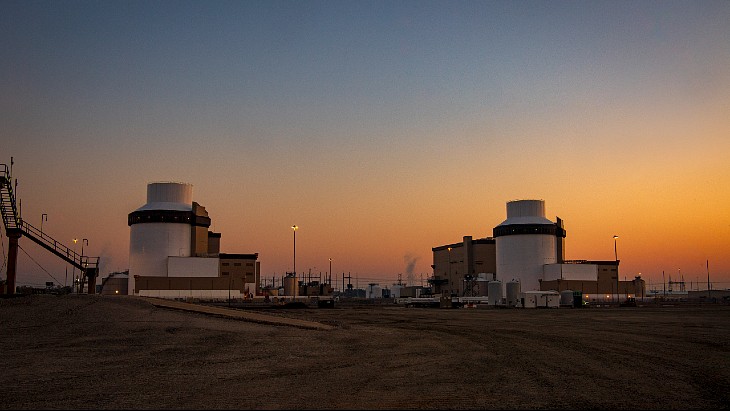
The Barakah plant - in the Al Dhafra Region of Abu Dhabi - is owned by ENEC and operated by Nawah, a joint nuclear operations and maintenance subsidiary of the ENEC and the Korea Electric Power Corporation.
Construction of the four Korean-designed APR-1400 units at Barakah began in 2012, with work on unit 4 beginning in 2015. Unit 1 began commercial operation in April 2021, unit 2 in March 2022. Unit 3's start-up was in September 2022, and it began commercial operation in February 2023. Unit 4 entered commercial operation in September 2024.
The USA and Israel launched attacks on Iran on 28 February, saying they were targeting Iran's leadership and its military infrastructure. Iran has retaliated - including attacks on neighbouring states. The conflict is continuing, although there is currently an official ceasefire, which is aimed at allowing talks seeking an agreement on ending the conflict.
The IAEA has warned about avoiding military action in the areas of nuclear power plants in the Ukraine-Russia war, and in March the agency reported that "a projectile incident" took place 350 metres from the Bushehr Nuclear Power Plant reactor in Iran.


_51287.jpg)