The application for the permit was submitted to the regulator - Nükleer Düzenleme Kurumu (NDK) - in May 2025. The documents detailed "the unit's commissioning stages, associated technological operations, and the operating personnel training process", and exceeded 22,000 pages in total.
In granting the permit, the NDK said "Akkuyu Nuclear Inc is authorised to conduct commissioning tests prior to nuclear fuel loading" in accordance with its regulatory requirements.
Turkey's nuclear regulator issued a permit for the first unit to be commissioned in December 2023, and it is currently preparing for hot and cold testing with dummy fuel loaded.
Developments this year at unit 2 include the 437-tonne turbine generator stator being moved on a special track before being lifted into place in the turbine hall of unit 2 in January, and in March the polar crane was installed in its position, which will be under the reactor building’s inner containment dome. Last month the passive core flooding system tanks - the last large components of the reactor plant primary circuit to be installed using the Open Top technology - were installed. The next phase of work includes installing the sixth tier and the dome of the inner containment building.
Sergey Butskikh, CEO of Akkuyu Nuclear JSC, said: "Obtaining the commissioning permit confirms compliance with regulatory requirements regarding the preparation of supporting documentation and allows us to begin preparations for commissioning operations at the second power unit. In parallel with construction work, specialists will begin the sequential testing and adjustment of equipment."
Background
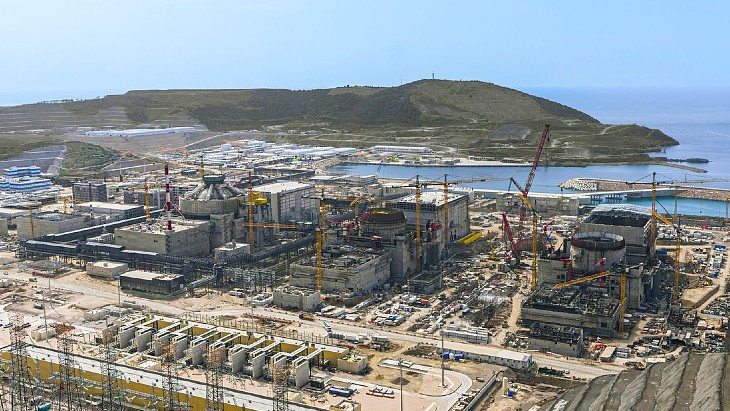
Akkuyu, in the southern Mersin province, is Turkey's first nuclear power plant. Rosatom is building four VVER-1200 reactors, under a so-called BOO (build-own-operate) model. According to the terms of the 2010 Intergovernmental Agreement between the Russian Federation and the Republic of Turkey, the aim was for the commissioning of the first power unit of the nuclear power plant to take place within seven years from receipt of all permits for the construction of the unit.
The licence for the construction of the first unit was issued in 2018, with construction work beginning that year. Nuclear fuel was delivered to the site in April 2023. The aim is for unit 1 to begin supplying Turkey's energy system during 2026. When the 4,800 MWe plant is completed, it is expected to meet about 10% of Turkey's electricity needs. All four units are under construction - first concrete for the fourth unit was poured in July 2022.
Turkey has plans for a second nuclear power plant, at Sinop, and has also been in talks with China about plans for a third plant, in the Thrace region in the country's northwest.
The country is also developing plans for small modular reactors, with the aim of adding 5 GWe of capacity by 2050 - which would mean the equivalent of at least 16 individual SMRs.
According to the International Atomic Energy Agency, commissioning is "the process by means of which systems and components of facilities and activities, having been constructed, are made operational and verified to be in accordance with the design and to have met the required performance criteria". The process includes testing and monitoring before, and throughout the start-up steps, to ensure the reliable and safe operation of a new nuclear power plant.


_51287.jpg)
_82983_12913.jpg)