In this episode, Karthik Subramanian, Chief Engineer and Innovation Director for Hanford Tank Waste Operations Closure, discusses the progress of the work taking place at Hanford - which is a 586 square mile site, about the same size as London - and the plans to clean-up, regenerate and re-industrialise the area, emulating a model demonstrated at the Oak Ridge and Savannah River sites.
He says that as well as the value of the land, there is also the value of an experienced, skilled workforce at decommissioning sites, and pre-existing approvals as a nuclear site.
"Many of these sites are seen as liabilities, and decommissioning is seen as a liability by governments. They need to be seen as assets, an asset that can be accessed. And that conversation, when it changes to 'how do we access this asset', that is a conversation we need to have with the private financing sector ... whether nuclear turns to nuclear or nuclear turns to solar or nuclear turns to whatever industry, when we can start talking about these sites as an enterprise, as an enterprise asset, as an institutional national asset, whether it be land or the skilled workforce or whatever, is when that conversation begins to take hold with the private industry," he said.
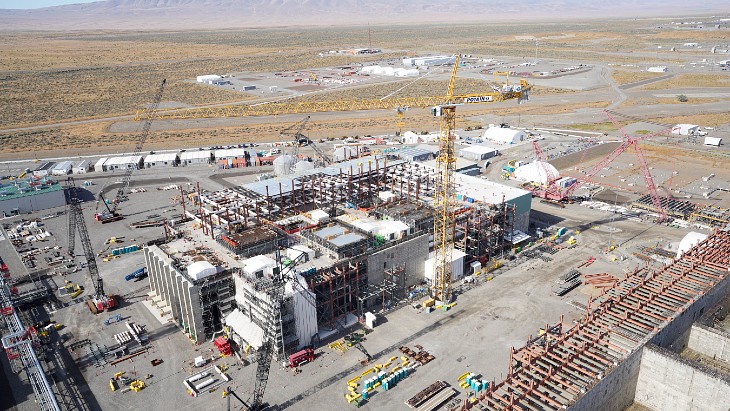
Hanford's High-Level Waste Facility, is currently under construction (Image: US DoE)
He is joined by his Amentum colleague Mike Houghton, vice president of the environment division within Energy and Environment International, for a wider conversation on decommissioning and how to increase opportunities for private finance: "Financing is critical, and I think there's various models around in other sectors that allow private finance to be utilised alongside public finance. I think what's changing over recent years is the insight into the value that these sites have. The new nuclear renaissance is really helping with that. You can see the value of existing sites - they've got a skilled workforce, they've got grid connections, they've got a licence as a nuclear site. They've usually a community around them that's supportive. So there’s real value in these areas."
Here is an edited transcript of the interview:
About the Hanford site
Karthik Subramanian: "The Hanford site covers 586 square miles, so it's an enormous operation. Originally, over 40 years, the Hanford site was involved in the production of nuclear materials for weapons production, including plutonium, supporting the defence industry for decades through nine reactors, multiple separations facilities, storage facilities. And out of that came a large amount of chemical and radioactive waste. There are 177 tanks that contain about 56 million gallons of waste, chemical and radioactive waste. And so the largest tank waste cleanup mission is ongoing at Hanford. There's been success in building and operating a vitrification plant for low-level waste, success in getting to a position in which we can take waste into a grouted waste form and now we're moving into cleanup not only for the tank waste, but of all the subsurface cleanup that needs to be done. Hanford started in the early 1940s. And so you're looking at 80 years of work and then probably another 30 to 50 years of cleanup going on at the Hanford site. From the defence mission standpoint, there was a workforce that was able to support all of that work and now that same support and that local community is supporting the cleanup mission. Now, moving forward as part of that cleanup mission, the Department of Energy and the US government has exercised some great creativity in how do you access this 586 square miles once cleanup is done, to regenerate, to re-industrialise, to revitalise that. Success in cleanup and moving into the cleanup mission, that will take some time, in the meantime, there is an incremental approach to accessing parts of that site."
Hanford's history
KS: "It was part of the original Manhattan Project. The B reactor was the first reactor to go critical and it is now a National Park Service landmark, a National Historical Site. So if you get out to Hanford, it's very interesting you can visit, Oppenheimer has a desk at the B reactor with his name on it. It's an amazing bit of history there."
The tank waste
KS: "These are underground metal tanks that contain the tank waste that was produced, liquid waste originally, but which now has become sludge, salt cake, and liquid waste. There's a great amount of work in remote retrieval technology, in remote inspection technology. Part of what we do is asset care to ensure safe storage. So inspection technologies, corrosion technology, structural analysis. We work hand in hand with the national laboratories that are a big part of supporting the technical basis for it. They are underground tanks that contain this waste and we at the Hanford site go from safe storage to what we call retrievals to move it into newer-style tanks. Then we pre-treat the waste and we immobilise the waste to ultimate closure."
"The ultimate aim is to take that waste and then immobilise it in a waste form that'll hold the waste for geologic timeframes. And so with the volume and mass of the waste that we have, it's another 30 to 40 to 50 years of working through that waste, depending on which waste we're working on. We have just now started the vitrification facility for the low-level waste, and it's working extremely well. We're now about several million gallons into pre-treating the waste with what's called a tank-side caesium removal system, a modular system that does filtration and caesium ion exchange to capture caesium. As we move forward, we have a plan to perform that action in other parts of the Hanford site. And so the technology has been demonstrated, and we continue to do more technology work and make the whole process more efficient."
"The high-level waste vitrification facility is being built and we'll move into high-level waste vitrification when that facility comes online. Today, it's low-level waste vitrification that's ongoing. And also a project to do low-level waste, low-temperature waste forms, grouting or cement waste forms using commercial facilities outside the state of Washington. The new regulatory framework has really been successful in accessing as many technologies as possible to make the Hanford mission more efficient and bring forward the end date of the Hanford mission. And the Department of Energy, the owner of the site, has been really taking a great leadership position in negotiating those things with our regulators."
"Each of the sites in the US has got a comprehensive land-use plan that is part of the structure. Hanford has one … a programme to enter industrial land use on the Hanford site. Oak Ridge has been successful doing that as well. Other sites, Savannah River is now moving into that area. So again, under government leadership and the contractor leadership and creativity, they've been moving into these arenas in which they're accessing these large sites. And I think part of that is that we underestimate the workforce that's there, the technical, the skilled craft, skills that are on these sites. These are large technical, nuclear, chemical processing facilities that have been around a long time. So the workforce in those local areas is a highly skilled, highly talented workforce that knows how to work in a disciplined manner on these sites. Oftentimes, we look at just the technical portions - acres of land - but the reality is, in order to be able to revitalise industrial uses of these sites, it's the workforce and the skilled workforce that comes with that experience, that right education, whether it be engineering, operations, maintenance, craft. And I think that workforce is critical to underpin any revitalisation efforts."
Has the idea of decommissioning being just a cost liability been changing?
Mike Houghton: "Both Karthik and myself were at the BNP Paribas Asset Management Decommissioning Conference in London where there were also representatives from all sectors - mining, oil and gas and renewables as well - in conversation with the finance community, government representatives from many different countries. There was a very positive discussion to understand the liabilities that sit around these various sectors. In many other sectors, it's considered that the liabilities are underestimated, but the issue is how transparency can be brought to all sectors from a liability costing perspective and how innovative ideas for financing solutions can be considered."
KS: "There was a lot of interest in the nuclear side of things. I think for the finance industry, it is really an education system. The more we can educate the finance industry with the technical details of the nuclear work stream, the more they become comfortable with the opportunity that is there. And so here's our chance to bring and integrate and collaborate with the finance team as a nuclear industry to ensure them that there is a risk, but it's a controlled risk."
MH: "I think it's important to start thinking around decommissioning, not just about the liabilities, but the opportunity and the opportunity to move into a transition and look forward to how can we reuse sites? Much of the conversation is around how can finance and finance and delivery models influence that? How can we work more with the stakeholders, the local communities to think about, and be creative about the opportunities for these sites? Understanding the successes at sites in the US like Oak Ridge and ideas that Hanford are exploring and how can they be employed in the UK as well. So trying to come up with ideas that the industry can utilise, think about, and move the conversation forward."
What is accelerated decommissioning?
MH: "I think the first thing to say about accelerated decommissioning, is that it's not about cutting corners or rushing. It's about thinking more carefully about getting the planning right - so earlier planning, thinking carefully about the sequencing of those activities so we can do them in a timely manner in the right order and thinking at the same time about the future uses of the site. So you don't wait until you've cleaned the site up. You start to think earlier about the future potential for that site. When we talk about acceleration, it's about doing things in a timely manner and being able to reduce the overall hotel costs for that particular site or operation."
KS: "System planning is a really important part of accelerating decommissioning. Having an end vision, and once we agree on what that end vision looks like and the transition vision looks like, then the technical portions of that will follow. We have access to a lot more tools now to execute our work on a technical scale. Whether it be design work, whether it be control systems, remote handling, robotics, all these things. I think harnessing technologies is part of accelerating decommissioning, and bringing commercial tools to bear. There also needs to be agreement on what the end vision looks like, and then the opportunity to system-plan your way to an end result while harnessing all the new technologies that come along the way. This is hard work and maintaining a safe envelope is really important."
MH: "Overall, if we can safely decommission the sites around the world - and that there are increasing number of ... reactors and operations that are going to be decommissioned over the next 20, 30, 40 years - if we can do that safely as an industry, that secures and protects the ability to have new generation as well, electricity generation through SMRs, AMRs, new gigawatt stations. So safely decommissioning and hazard-reducing the sites around the world is important to the industry. It's important that we share that learning and we get the best benefit for the industry across the world. Reducing the costs through learning new technologies and being able to confidently predict the liability costs is an important element for governments and owners of the sites."
Should more be invested to speed up decommissioning?
MH: "Governments are pressed for money and they're focusing their spending in areas that ensure safety, so in the UK to ensure that the highest hazards are addressed. You're also seeing maintaining safety for the lower hazard areas. Financing is critical, and I think there's various models around in other sectors that allow private finance to be utilised alongside public finance. What is the role for the private sector to come in and support the government sector? I think what's changing over recent years is the insight into the value that these sites have. The new nuclear renaissance is really helping with that. You can see the value of existing sites - they've got a skilled workforce, they've got grid connections, they've got a licence as a nuclear site. They've usually a community around them that's supportive. So there’s real value in these areas.”
KS: “This is the crux of the discussion going on globally. Many of these sites are seen as liabilities, and decommissioning is seen as a liability to the UK government, the Japanese government, or the US government. They need to be seen as assets, an asset that can be accessed. And that conversation, when it changes to 'how do we access this asset', that is a conversation we need to have with the private financing sector. I listened to the conference and we've heard the term 'closure' over and over - it's not 'closure', it's an opening. And whether nuclear turns to nuclear or nuclear turns to solar or nuclear turns to whatever industry, when we can start talking about these sites as an enterprise, as an enterprise asset, as an institutional national asset, whether it be land or the skilled workforce or whatever, is when that conversation begins to take hold with the private industry. So the more that we as an institution and enterprise can show the value of the asset versus the depreciation of the liability, then I think that's, I’m by no means a finance person, so I'm probably using all these terms incorrectly, but it's an asset that has yet to be accessed. So if we can turn that corner into assets vs liabilities, then on balance, I think the private industry will see that the opportunity is there.”


_98552.jpg)
_1_12560.jpg)
_22582.jpg)