The issue
CERN, the European Council for Nuclear Research, is located near Geneva in Switzerland. Its underground Large Hadron Collider (LHC) consists of a 27-kilometre ring of superconducting magnets in which subatomic particles are accelerated to nearly the speed of light under ultra-high-vacuum conditions at temperatures of minus 271°C.
There are a number of accelerating structures to boost the energy of the particles along the way and the beams inside the LHC are made to collide at four locations around the accelerator ring, corresponding to the positions of four particle detectors.
There are 2,000 Plug-in Modules to help handle the extreme conditions in the beamline pipes as they heat up and cool down. But over time, small components within these modules can bend slightly due to thermal cycling, which can create obstructions inside the beamline, disrupting experiments and causing delays.
The solution
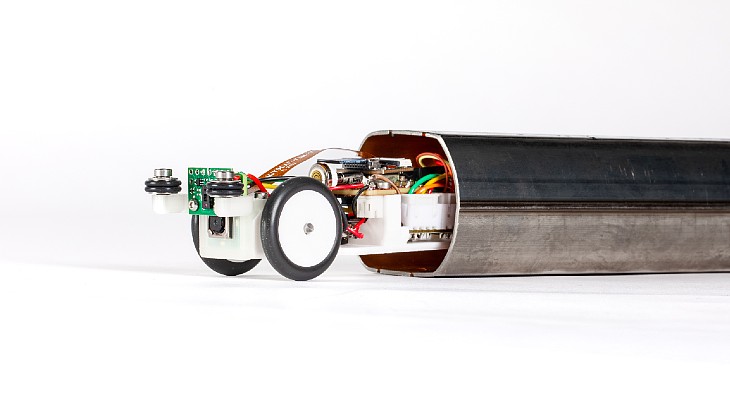
Teams from CERN and UK Atomic Energy Authority's robotics centre have developed the PipeINEER small robot, which runs on wheels, can fit through spaces as narrow as 3.7-centimetres by 3.7-centimetres inside the beamline and can inspect up to six kilometres on one battery charge.
UKAEA says that the mini-robot "captures detailed images of each Plug-in Module and uses artificial intelligence trained on real LHC imagery to detect any abnormalities. If the robot detects an issue, it returns to its starting point and reports the exact location of the problem. This targeted approach allows engineers to address specific points along the 27-kilometre collider, without disassembling large sections of pipe and using a manual endoscope - a process that is extremely time-consuming and expensive".
The robots are currently in the development stage, with performance being tested during the year. The plan is for final units to be manufactured in late-2026 and CERN operators to be trained on the new units in early 2027.
Giuseppe Bregliozzi, Beam Vacuum Operation Section Leader, CERN, said: "PipeINEER will transform how we inspect and maintain the LHC. It marks a major step forward in keeping our experiments running smoothly."
Nick Sykes, Director of the UKAEA's Remote Applications in Challenging Environments robotics centre, said: "We're proud to apply our robotics expertise from fusion energy to support CERN’s world leading experiments. By combining our remote handling experience with CERN’s scientific excellence, we’re helping ensure the Large Hadron Collider operates safely and efficiently for years to come."
Explanatory video
Background
CERN says its mission is to help "uncover what the universe is made of and how it works. We do this by providing a unique range of particle accelerator facilities to researchers, to advance the boundaries of human knowledge". Best known amongst these has been the Large Hadron Collider, which started up in 2009. CERN was also where the Higgs boson was discovered in 2012 as well as being the birthplace of the World Wide Web. CERN has 23 Member States, 10 Associate Member States and includes 17,000 people from all over the world, with more than 110 nationalities represented.
The UKAEA carries out fusion energy research on behalf of the UK government, overseeing the country's fusion programme, including the MAST Upgrade (Mega Amp Spherical Tokamak) experiment as well as hosting the recently closed Joint European Torus (JET) at Culham, which operated for scientists from around Europe. Its Remote Applications in Challenging Environments robotics centre specialises in designing robots for hazardous and hard-to-reach places, including fusion energy, nuclear facilities and space structures.


_51287.jpg)