The Russian state nuclear corporation said the new type of heat-resistant steel was developed by specialists at the Central Research Institute of Mechanical Engineering Technology (TsNIITMASH), its mechanical engineering division.
It said that the BR-1200 fast neutron reactor's operating temperature compares with 320-350 degrees Celsius in VVER-type reactors.
Sergei Logashov, Deputy Director General and Director of the Institute of Materials Science at TsNIITMASH, said: "This development is based on our many years of experience creating materials for heavy liquid-metal coolant systems and the use of computer modeling. The resulting material combines the radiation and corrosion resistance required for the BR-1200 primary circuit, thermal stability at temperatures up to 600 degrees Celsius, and, most importantly, surpasses the reference EP302 steel (currently used for nuclear power plant structures operating in contact with liquid-metal coolant) in long-term strength."
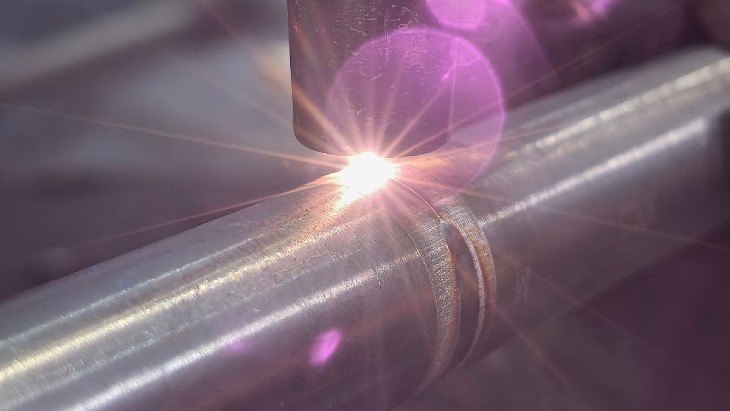
The specialists also tested laser welding technology for austenitic and ferritic-martensitic steels and, Rosatom says, "the studies showed that laser welding significantly increases the productivity of welded structures (compared with traditional arc welding methods, while maintaining high weld quality). Importantly, the new technology can also be implemented on existing reactor units, both VVER and RITM".
The background
The 1200 MWe (2800 MWt) BR-1200 is a lead-cooled fast reactor under development - its prototype is the BREST-OD-300, which is under construction in Seversk. It is part of Rosatom's Proryv, or Breakthrough, project to enable a closed nuclear fuel cycle.
A two-unit BR-1200 nuclear power plant is planned for Seversk, with the units scheduled to come online in 2036 and 2038.


_51287.jpg)